
Highest Win Rate Trading Strategy Review (June)

TradingCup
JUL 01 2025
Last Updated: July 17, 2026
This article is reviewed annually to reflect the latest market regulations and trends.
Disclaimer: The information in this article is for educational purposes only and does not constitute financial, investment, or trading advice. Copy trading carries substantial risks, including the potential loss of your entire invested capital. Past performance of copied traders or strategies is not a reliable indicator of future results. You may be replicating high-risk trades, overleveraged positions, or strategies incompatible with your financial goals. Always conduct independent research into a trader’s historical performance, risk metrics, and strategy before copying them. Never invest funds you cannot afford to lose. Consult a licensed financial advisor to ensure copy trading aligns with your risk tolerance, financial objectives, and regulatory requirements in your jurisdiction. This article does not endorse specific traders, platforms, or strategies, and all trading decisions remain your sole responsibility.
TL;DR (Too Long, Didn’t Read)
- A high win rate can deceive, a lesson an investor must receive.
- Big gains with low risk, is the goal one shouldn’t miss.
- Copy five traders or more, to spread risk and even the score.
- Check trades now and then, like a wise portfolio hen.
- Use smart tools to select, for a future to protect.
“The game of speculation is the most uniformly fascinating game in the world. But it is not a game for the stupid, the mentally lazy, the person of inferior emotional balance, or the get-rich-quick adventurer. They will die poor.” – Jesse Livermore
Highest Win Rate Trading Strategy Review (June) – The Truth
Many aspiring investors find themselves in a familiar position. They are driven individuals with demanding jobs, family commitments, and a powerful desire to make their capital work for them. The foreign exchange (forex) market, a global arena that never sleeps, presents itself as an alluring opportunity. Yet, the complex charts, esoteric jargon, and rapid price movements can feel like an insurmountable barrier.
In this search for a viable path, many discover a beacon of hope: copy trading. The concept appears to be the perfect solution, a way to participate in the market’s potential without dedicating years to mastering its complexities. The most logical first step, it seems, is to find the trader with the best track record, the one who wins the most trades. This leads to a focused search for the “highest win rate trading strategy.”
This presents a critical question for any new market participant: Is the pursuit of the highest win rate the secret to success, or is it a dangerous trap for the uninformed? The answer lies in understanding that what seems intuitive is often the enemy of profitability in financial markets. This review will deconstruct this myth and provide a professional framework for making smarter decisions on the journey into forex copy trading.
What Exactly is Forex Copy Trading?
Forex copy trading is a technology-driven service that enables an investor to automatically link a portion of their portfolio to the account of a signal provider. When the signal provider executes a trade, that same trade is automatically replicated in the investor’s account in real-time, proportional to the funds allocated. This system is designed to bridge the knowledge and experience gap, allowing those new to the markets to participate by leveraging the expertise of seasoned professionals.
Is Copy Trading a Perfect Fit for a Busy Beginner?
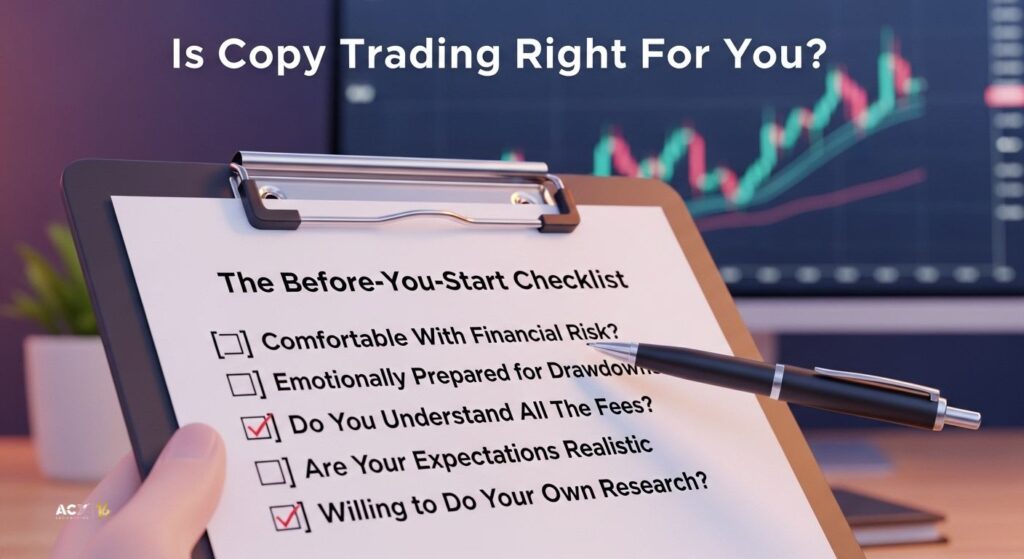
Copy trading isn’t for everyone. Before you jump in, consider this checklist:
- Are you comfortable with risk? All trading involves risk, and past performance is not indicative of future results. Even the best traders have losing streaks.
- Do you have capital you can afford to lose? Never invest money you can’t afford to part with.
- Are you looking for a passive investment? While copy trading is less hands-on, it still requires initial research and ongoing monitoring.
- Do you understand the fee structures? Subscription fees and performance fees can eat into profits.
- Are you patient? Quick riches are rare. Successful trading, even copying, often requires a long-term perspective.
- Are you willing to do your due diligence? Selecting a trader requires careful analysis of their history, strategy, and risk management.
- Do you have realistic expectations? Don’t expect to double your money overnight.
- Are you emotionally prepared for drawdowns? Seeing your account balance dip, even temporarily, can be stressful. Maximum Drawdown (MDD) is a key metric to understand.
If you’ve nodded along to these points with a clear understanding, then XAUUSD copy trading might be a suitable avenue for you to explore.
Before Copying, An Investor MUST Understand ROI
The journey away from the flawed “win rate” metric leads directly to a far more powerful and truthful measure of performance: Return on Investment (ROI). ROI is the ultimate indicator of profitability because it measures how effectively capital is being used to generate profit.
The formula is straightforward and essential for any investor to understand:
ROI=Cost of InvestmentNet Profit×100%
Where Net Profit is the gain from the investment minus the cost of the investment.
This is where the advantage of a high-quality, transparent copy trading platform becomes paramount. In the past, an investor might be tempted to purchase an expensive “black box” Expert Advisor (EA) or an AI trading bot. These tools often operate with a complete lack of transparency, making it impossible to verify their strategy or true performance. The stated ROI could be misleading or unverified.
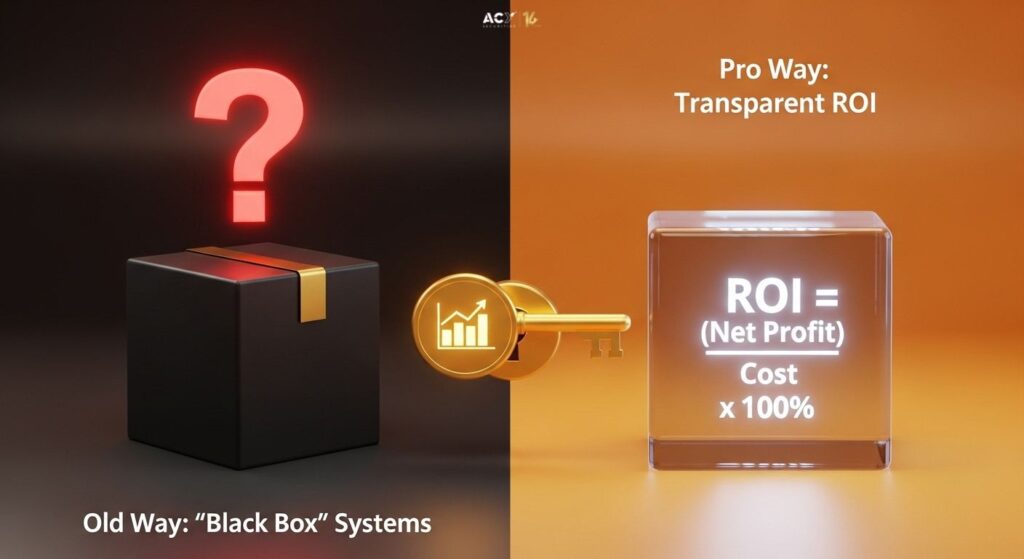
A platform like TradingCup, however, provides this critical data transparently. The Gain (a proxy for ROI), the full, verified trade history, and other crucial metrics are available for scrutiny. This transparency empowers the investor to apply the professional principles of analysis taught by legends like Livermore and Elder. The platform itself becomes the tool that enables smart, data-driven decision-making, transforming the user from a passive follower into an informed investor.
The June Shortlist – Who Are the Highest-Performing Traders to Watch?
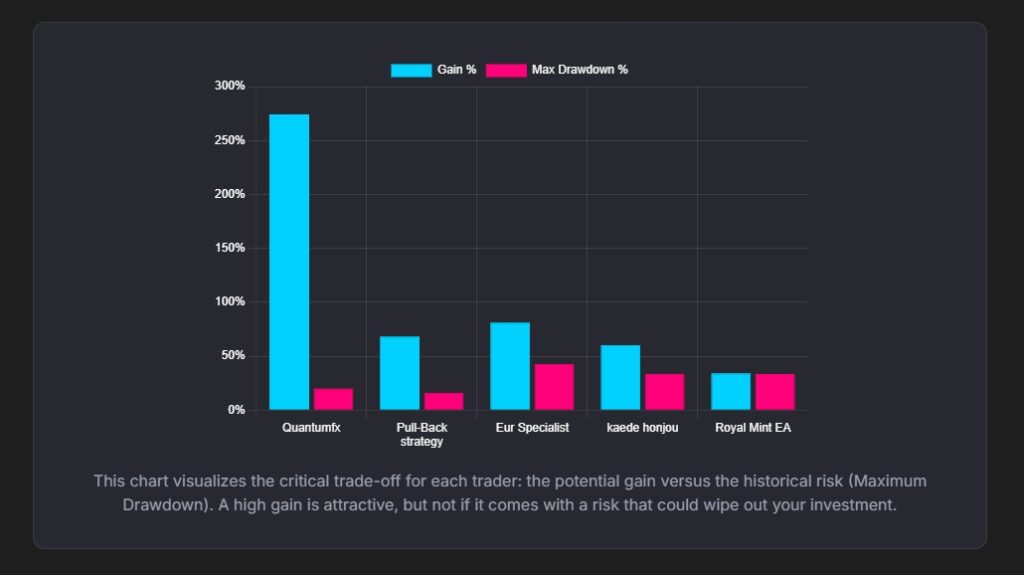
An Expert Analysis of Top Traders: Beyond the Hype
The following analysis moves beyond a superficial look at “Gain %.” Applying the core lessons from this review, each trader is evaluated holistically, weighing their historical returns against the risks they took (Maximum Drawdown) and the costs they charge (Fees). This is a professional assessment designed to match traders with the right investor profiles.
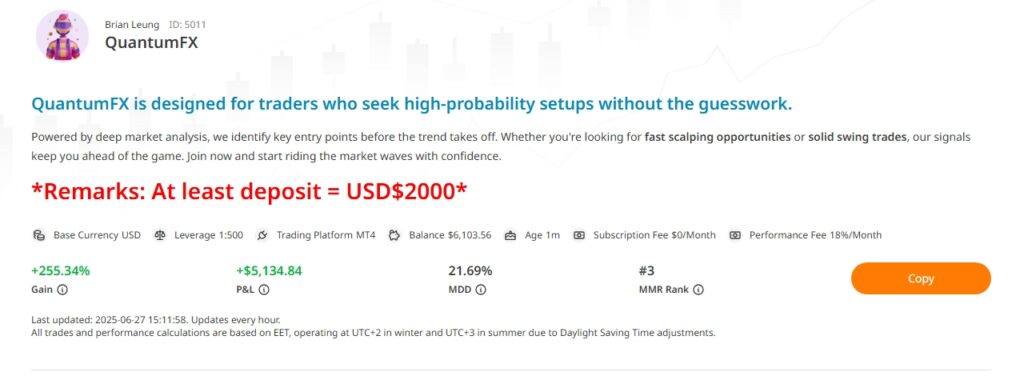
Quantumfx
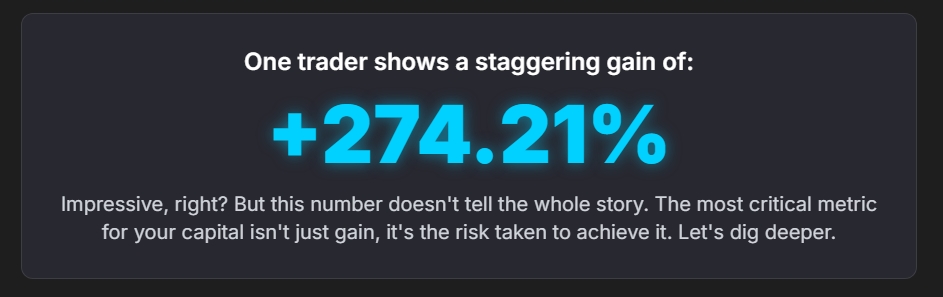
- Key Stats: Gain 274.21%, Maximum Drawdown (MDD) 20.14%, Fees 18% performance fee.
- The Investor Profile: This strategy is for the growth-oriented, aggressive investor. The potential for exceptional returns is clear, but it comes with a significant level of volatility, as evidenced by the 20.14% MDD. An investor must be comfortable with substantial swings in their account equity. The 18% performance fee is a premium paid for this high-octane performance.
- The Livermore/Elder Question: The gain-to-drawdown ratio is strong, suggesting effective profit-taking. However, a 20.14% drawdown is substantial. To adhere to Dr. Elder’s 6% monthly account risk rule, an investor would need to allocate a smaller portion of their total capital to this single strategy to contain the potential impact of a worst-case drawdown.
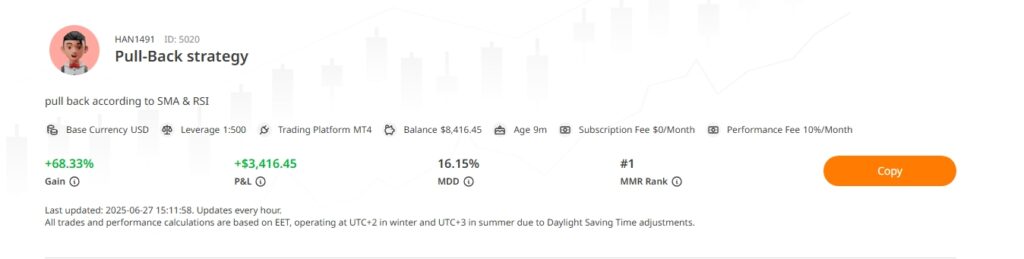
Pull-Back strategy
- Key Stats: Gain 68.33%, MDD 16.15%, Fees 10% performance fee.
- The Investor Profile: This strategy suits a more moderate or conservative-growth investor. The returns are less spectacular than Quantumfx, but the historical risk taken is also lower. The 10% performance fee is more standard, making it an attractive, balanced option for someone prioritizing capital preservation alongside steady growth.
- The Livermore/Elder Question: This trader demonstrates a solid risk-reward profile. The lower drawdown is appealing from a risk management perspective. This could be a core holding in a diversified copy trading portfolio, providing stability to complement more aggressive strategies.
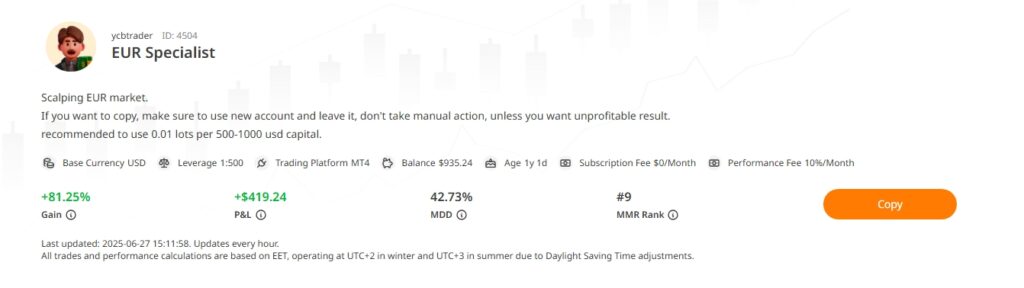
Eur Specialist
- Key Stats: Gain 81.25%, MDD 42.73%, Fees 10% performance fee.
- The Investor Profile: This strategy is for the extremely high-risk, speculative investor only. While the gain is impressive, the 42.73% maximum drawdown is a major red flag for most. This level of drawdown could be devastating to an unprepared investor’s capital and emotional state.
- The Livermore/Elder Question: This profile serves as a perfect educational example of why win rate and gain alone are dangerous metrics. A 42.73% drawdown indicates a strategy that likely holds onto losing trades for too long or uses excessive leverage, violating the core principles of both Livermore and Elder. The risk taken far outweighs the reward for a typical investor.
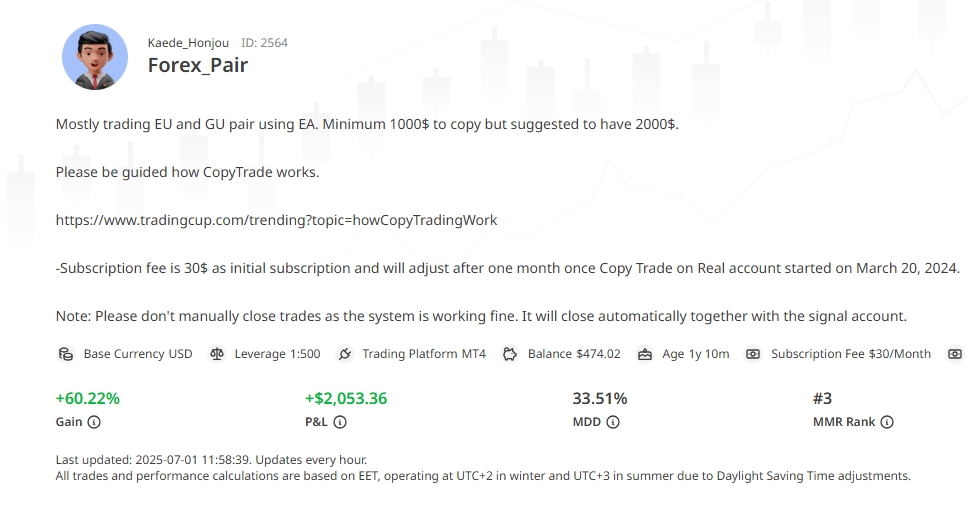
kaede honjou
- Key Stats: Gain 60.27%, MDD 33.51%, Fees $30/month subscription.
- The Investor Profile: This strategy is for an investor who prefers a fixed-cost model. The subscription fee means costs are predictable and not tied to performance. However, the 33.51% drawdown places this firmly in the high-risk category. The investor pays the fee regardless of whether the month is profitable or not.
- The Livermore/Elder Question: The high drawdown is a significant concern. The fixed-fee model can be a double-edged sword; it’s beneficial in highly profitable months but becomes a drag on capital during flat or losing periods. An investor must have high confidence in the strategy’s long-term edge to commit to a recurring subscription cost coupled with this level of risk.
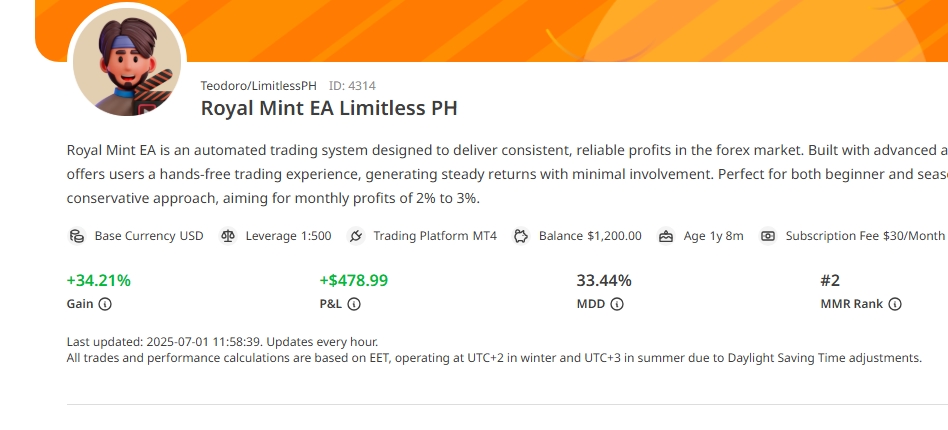
Royal Mint EA
- Key Stats: Gain 34.21%, MDD 33.44%, Fees $30/month subscription + 2%/month performance fee.
- The Investor Profile: This strategy is for an investor who understands hybrid fee structures. The returns are the most modest of the group, yet the drawdown is high, nearly matching the gain. This presents a challenging risk/reward proposition.
- The Livermore/Elder Question: The risk profile is concerning. The historical maximum drawdown is almost equal to the total gain, suggesting a poor risk-adjusted return. An investor would be taking on a significant amount of risk for comparatively modest returns, a structure that would likely be unattractive to a disciplined, risk-focused investor following the principles of Livermore or Elder.
The Hypothetical $2,000 Investment Copy Trading Test – A Cost-Benefit Analysis
To make these abstract numbers tangible, the following table projects the potential outcome of a $2,000 investment with each trader for one month, based on their historical average monthly gain. This is a simplified analysis to illustrate the interplay between gains, risk, and fees.
| Trader Name | Total Gain % | Avg. Monthly Gain % (est.) | Max Drawdown % | Fee Structure | Initial Investment | Projected Gross Profit | Estimated Fees | Projected Net Profit | Net Profit / Drawdown Ratio |
| Quantumfx | 274.21% | 22.85% | 20.14% | 18% Performance | $2,000 | $457.00 | $82.26 | $374.74 | 1.86 |
| Pull-Back strategy | 68.33% | 5.70% | 16.15% | 10% Performance | $2,000 | $114.00 | $11.40 | $102.60 | 0.64 |
| Eur Specialist | 81.25% | 6.77% | 42.73% | 10% Performance | $2,000 | $135.40 | $13.54 | $121.86 | 0.29 |
| kaede honjou | 60.27% | 5.02% | 33.51% | $30/month | $2,000 | $100.40 | $30.00 | $70.40 | 0.21 |
| Royal Mint EA | 34.21% | 2.85% | 33.44% | $30/month + 2% Perf. | $2,000 | $57.00 | $31.14 | $25.86 | 0.08 |
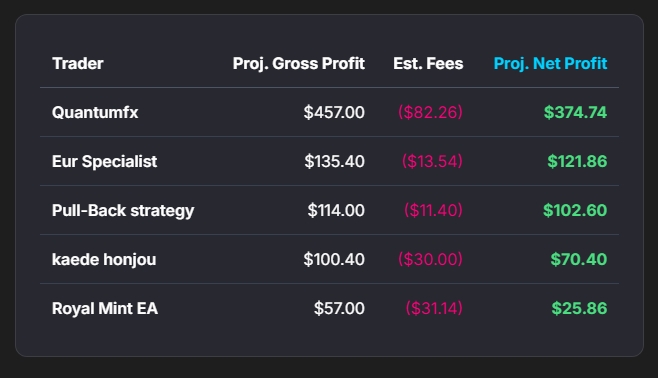
Note: This is a simplified projection based on historical data. Past performance is not indicative of future results. Avg. Monthly Gain is estimated by dividing Total Gain by 12. The ‘Net Profit / Drawdown Ratio’ is a guide to how much potential monthly return was generated per unit of historical risk.
This analysis reveals that Quantumfx, despite its high fees, has historically delivered the highest return per unit of risk. Conversely, strategies like Eur Specialist and Royal Mint EA show a much lower potential return for the high level of risk an investor would have to endure.
How to Find Your Own Forex Signals on TradingCup
The goal is not just to follow a list, but to learn how to fish. The TradingCup platform offers several powerful filters to help beginners find traders that match their specific risk tolerance and goals. Understanding these tools is key to becoming an effective manager of traders. Beyond Manual Search Below Are Filtered Lists From TradingCup
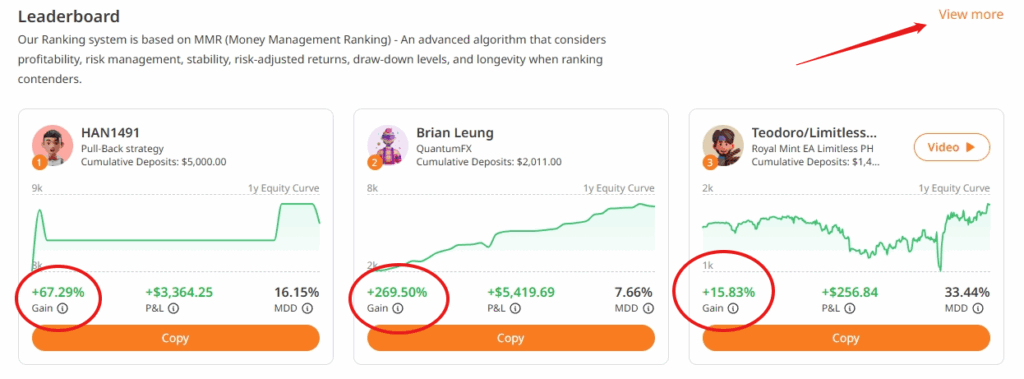
Leaderboard: Based on an MMR (Money Management Ranking) system or similar composite score, ranking traders holistically over their entire history.
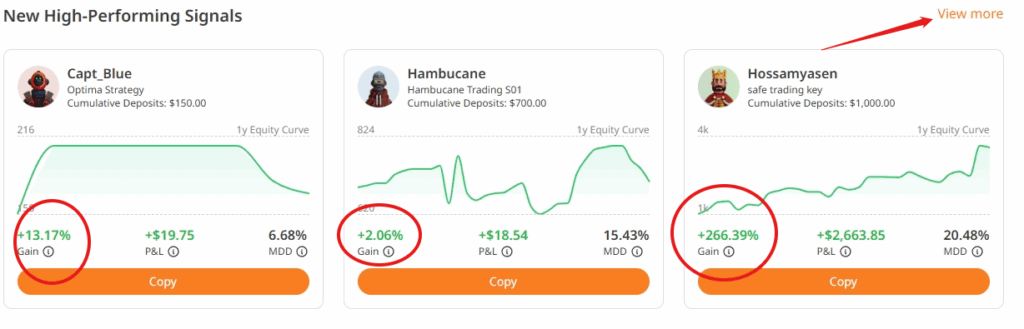
New High-performing Signals: Focuses on newer traders (e.g., < 1 year) showing positive Gain %. Good for finding emerging talent, but requires caution due to shorter track records.
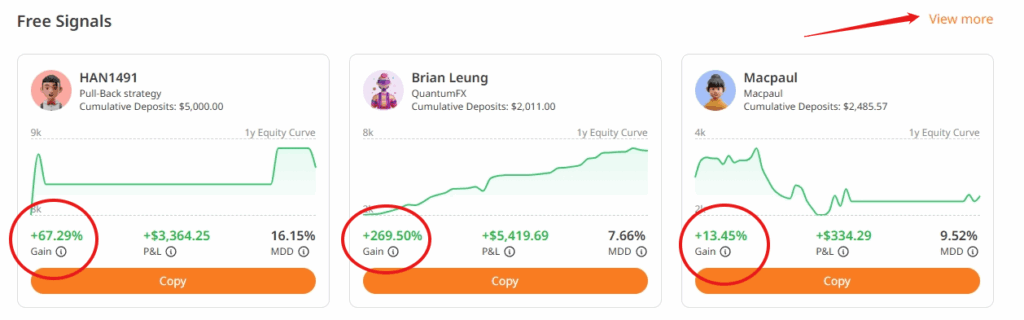
Free Signals: Focuses on traders (e.g., > 1 year) showing positive Gain %. Good for finding Free Signal Providers. A great starting point for beginners to try copy trading without incurring huge costs.
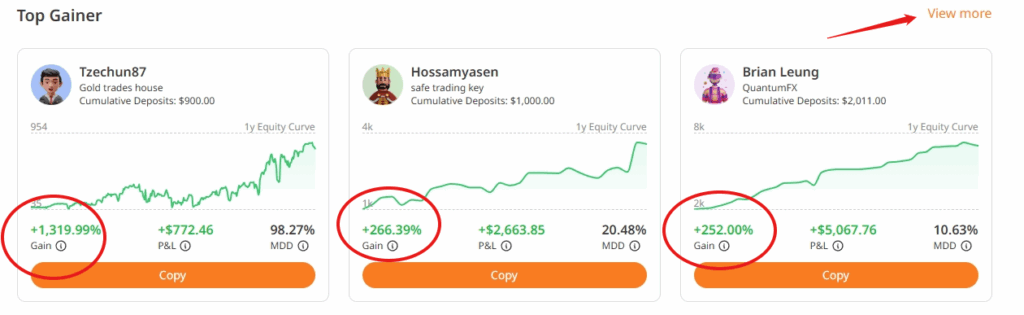
Top Gainer: Purely ranks by Gain % over a period (e.g., 1 year), often filtering for positive gain. Use with caution – high gain can mean high risk. Always check MDD and Sharpe Ratio here. It is tempting to simply sort all traders by the “Top Gainer” filter to see who is making the most money. This is the most direct path to finding traders like Jason Huang. While potentially lucrative, using this filter in isolation is the single most dangerous approach for a beginner. A high gain figure tells you nothing about the risk taken to achieve it.
A professional approach dictates that if you use the “Top Gainer” filter, you must immediately cross-reference the results with other critical risk metrics. The key questions to ask are:
What is the Profit Factor? This is the gross profits divided by the gross losses. A number greater than 1 means the strategy is profitable, but a higher number (e.g., >1.5) indicates more robust profitability.
What is the Maximum Drawdown (MDD)? A gain of 200% is less appealing when paired with an MDD of 50%, which means at one point, the strategy lost half of its value.
What is the Sharpe Ratio? This metric measures risk-adjusted return. A higher Sharpe Ratio (ideally >1.5) indicates the trader is generating better returns for the level of risk they are taking on.
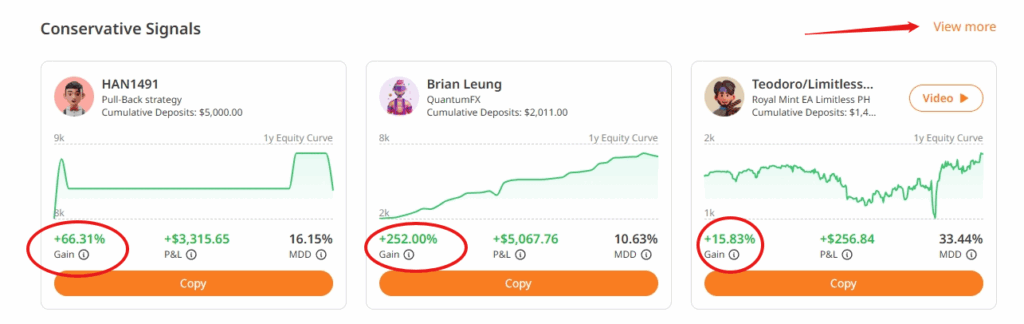
Conservative Signals: Filters for low risk, typically using a Maximum Drawdown threshold (e.g., <= 10% over 1 year) and often ranked by MMR within that subset. Ideal for risk-averse investors.
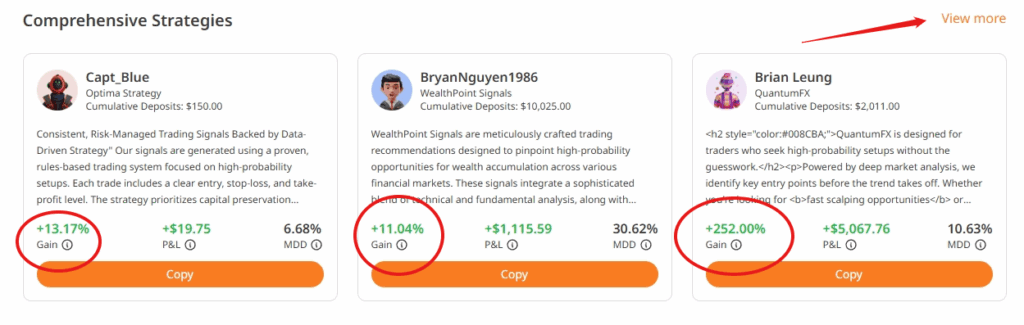
Comprehensive Strategies: Attempts to filter based on the quality and detail of the trader’s strategy description (looking for non-generic, non-volatile approaches like Martingale) combined with positive Gain %.
Why Putting All Your Eggs in One Basket is a Rookie Mistake: The Power of Five
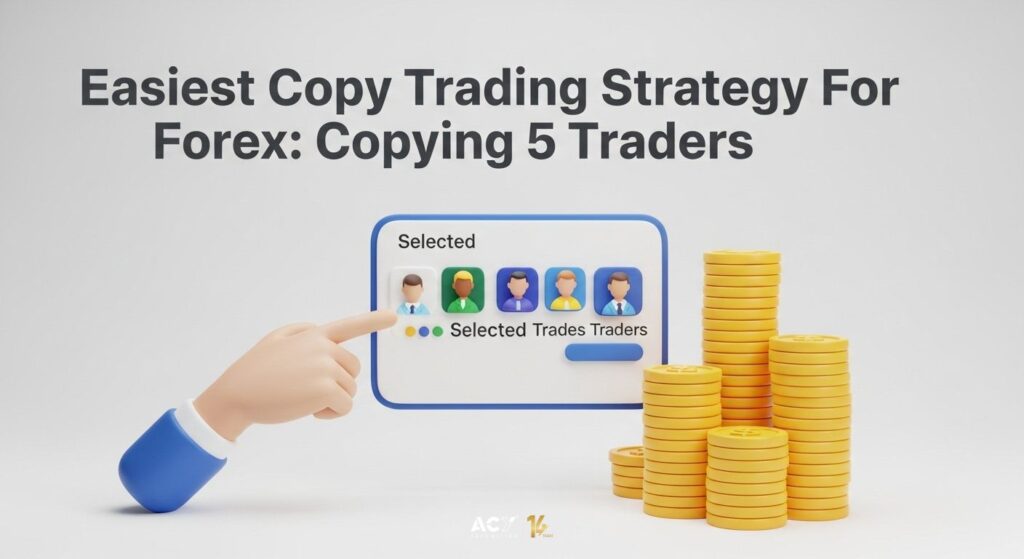
Once you have mastered the art of selecting a single trader, the next level of professional copy trading involves diversification. Relying on a single signal provider, no matter how skilled, exposes you to significant idiosyncratic risk. That trader could fall ill, change their strategy, suffer a psychological breakdown, or simply encounter a market environment that is hostile to their specific approach.
A more resilient approach, as suggested by an article on the TradingCup platform, is to diversify your capital across multiple traders, for example, by copying up to five different providers. The rationale is the same as for a traditional stock portfolio. By combining traders with different styles, you can build a more robust and stable equity curve. For example, you could construct a portfolio that includes:
- One or two conservative traders (low MDD) to act as the stable core.
- Two moderate traders (good MMR, solid long-term gains) as the primary growth engines.
- One specialist trader (e.g., one who only trades Gold or a specific currency pair) to add a non-correlated source of returns.
This diversification smooths out returns and reduces the impact of any single trader having a bad month. It transforms your copy trading from a single bet into a managed portfolio.
Are You Watching Too Much or Not Enough? A Practical Guide to Monitoring Your Portfolio
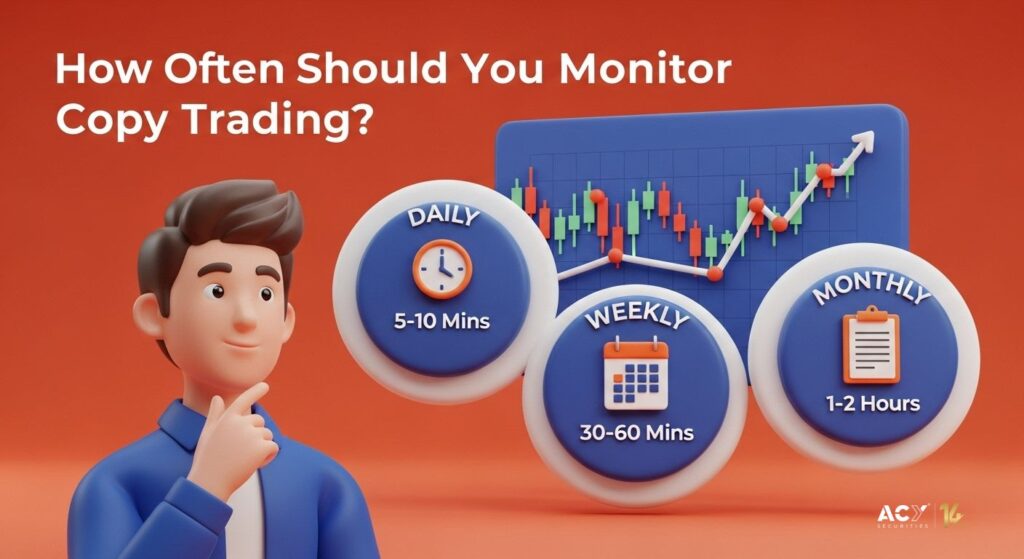
A common question from beginners is, “How often should I check my account?” The answer lies in finding a balance between informed oversight and obsessive monitoring. Watching every tick of the market is counterproductive; it invites emotional decision-making and anxiety. Conversely, a “set and forget” approach is negligent. A professional monitoring schedule might look like this:
- Daily (5 minutes): A quick check to ensure there are no major platform issues or catastrophic events. Look at the overall account balance, not individual trades. The goal is situational awareness, not analysis.
- Weekly (30 minutes): A more in-depth review. Check the performance of each individual trader for the week. Has their risk profile changed? Have they posted any updates or comments about their strategy? This is your primary check-in to ensure things are on track.
- Monthly (1 hour): A full strategic reassessment. Review each trader’s monthly performance against their long-term history and against your other traders. Is their strategy still aligned with your goals? Is it time to reallocate capital, or perhaps switch out an underperforming trader for a new one?
This structured approach, as outlined in guides on the subject , keeps you engaged and in control without succumbing to the emotional rollercoaster of minute-by-minute price movements
Don’t Copy Trade in a Vacuum: How to Leverage Expert Analysis for Free

One of the most powerful yet underutilized risk management tools is the educational ecosystem provided by your broker. Platforms like ACY Securities, which powers TradingCup, offer a wealth of free resources, including market analysis videos, webinars with senior analysts, and community channels on platforms like Discord and Telegram.
This provides a crucial “second opinion” and transforms you from a passive copier into an active, informed investor. Imagine this scenario: you are copying a trader who has taken a large position on the Japanese Yen. The trade immediately goes into a drawdown, and you begin to panic. Your emotional brain tells you to cut your losses and stop copying.
However, before acting, you join a free weekly market webinar hosted by an ACY analyst. In the webinar, the analyst provides a detailed breakdown of the Bank of Japan’s latest policy statement and explains the fundamental reasons why they anticipate Yen weakness in the coming weeks. This piece of expert, external analysis validates the thesis behind your copied trader’s position. It provides you with the context and confidence to stick with the trade, overriding your fear-based impulse. By leveraging these resources, you create a supportive framework that mitigates the fear and isolation that often lead to poor decisions.
Your Education Doesn’t End Here: Essential Next Reads
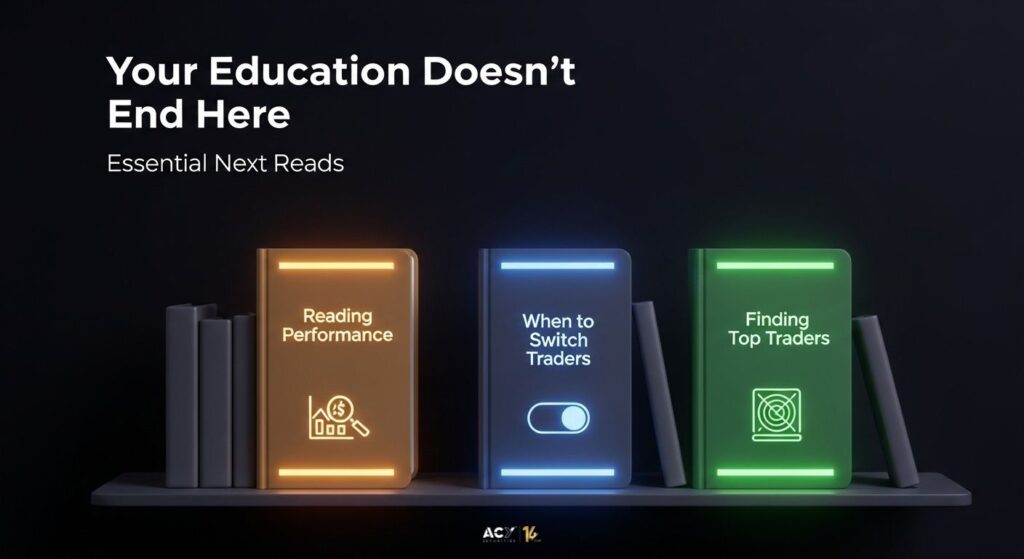
Becoming a professional-level copy trader is a journey of continuous learning. The analysis in this guide has provided a robust foundation, but to deepen your expertise, further reading is essential. The following resources provide critical insights into the nuances of trader selection and management.
- Who to Copy Trade: How to Read a Trader’s Performance Think you’ve found a star trader? Before you commit your capital, you need to learn how to look under the hood. A high profit number can be deceiving. This guide teaches you to read the full spectrum of performance metrics, from drawdown and Sharpe ratio to expectancy and profit factor, like a professional analyst. It will empower you to move beyond simple returns and truly understand a trader’s skill, risk profile, and long-term consistency.
- When to Switch Traders in Copy Trading Loyalty is a virtue in life, but in trading, blind loyalty can be a liability. Every great trader will experience periods of underperformance. The critical challenge is distinguishing between a temporary, acceptable drawdown and a sign that a trader’s strategy is fundamentally broken or no longer suited to the market. This essential read provides a clear, data-driven framework for making that difficult decision, helping you know when to hold ’em and when to fold ’em.
- How to Find Top Traders to Copy Trade A copy trading platform is a sea of potential, but finding the true gems requires a systematic approach, not just luck. Simply picking from the top of the default leaderboard is a novice move. This article dives deep into advanced search, filtering, and discovery techniques. It shows you how to combine different metrics and strategies to systematically uncover the top traders that align perfectly with your specific financial goals and personal risk appetite.
What Would Jesse Livermore Say About “High Win Rate” Traders?

Who Was Jesse Livermore, and Why Should An Investor Care?
Jesse Livermore was a titan of Wall Street, a legendary speculator who earned and lost fortunes multiple times over. Known as “The Boy Plunger” for his audacious trades and later the “Great Bear of Wall Street,” his name is synonymous with market mastery. He famously shorted the market before the 1906 San Francisco earthquake and again before the great crash of 1929, cementing his place in financial history.
However, Livermore’s story is not just one of triumph; it is also a cautionary tale. His catastrophic losses serve as a powerful reminder that even the most brilliant traders are subject to market risk and their own psychological flaws. It is from both his incredible successes and his devastating failures that the most valuable lessons emerge.
Why Is a High Win Rate a Dangerous Mirage?
The obsession with a high win rate is one of the most common and perilous mistakes a novice investor can make. The logic seems simple: winning more often should lead to more money. The reality is far different. A trader could theoretically achieve a 95% win rate by securing 19 small profits of $10 each, only to suffer a single loss of $300 on the 20th trade. The result is a stellar win rate but a net loss of $110. This simple mathematical reality exposes the metric as hollow when viewed in isolation.
Livermore’s core philosophy stood in direct opposition to the thinking that underpins high-win-rate strategies. He believed that the “big money” was not made in capturing frequent, minor fluctuations but in correctly identifying and patiently riding the market’s major trends, what he called the “main movements”. He would wait with immense discipline for the market to confirm his analysis at what he termed “pivotal points” before committing significant capital. He was not trying to be right all the time; he was trying to be right at the right time.
His most foundational rule, the principle that defined his career, was to cut losses quickly and let profits run. He famously stated, “a loss never bothers me after I take it… But being wrong, not taking the loss, that is what does damage to the pocketbook and to the soul”. This principle is the antithesis of many strategies that generate high win rates. Such strategies often achieve their impressive metric by holding onto losing positions, hoping for a reversal, thereby avoiding the realization of a loss. This practice of refusing to cut losses inevitably leads to catastrophic drawdowns when the market does not turn back.
Are You on the “Right Side” or Just the “Winning Side”?
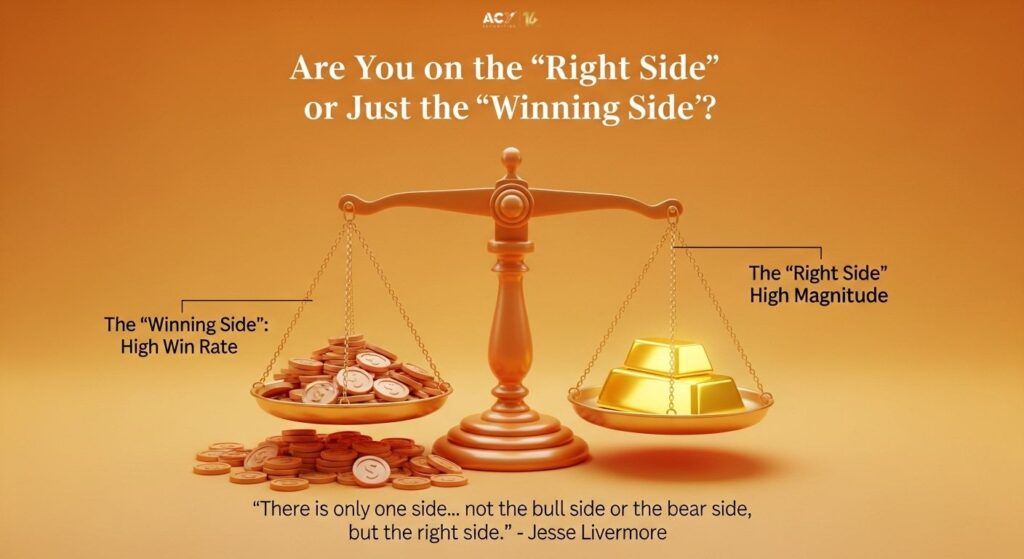
Livermore’s wisdom is encapsulated in his famous declaration: “There is only one side to the stock market; and it is not the bull side or the bear side, but the right side”. For him, the “right side” meant being aligned with the market’s dominant force, its primary trend. He was not concerned with the ego-driven need to be correct on every single trade. His entire methodology was built on superior risk management and maximizing the magnitude of his gains when his analysis proved correct. He would only scale into larger positions when the market was moving decisively in his favor, effectively risking more only when conditions were optimal.
In essence, Livermore’s philosophy teaches that the frequency of being correct is a vanity metric. What truly matters is the magnitude of profits when right versus the magnitude of losses when wrong. The psychological fortitude to accept many small, disciplined losses in exchange for a few enormous, trend-riding wins was the secret to his legendary success. For the modern copy trader, this means the critical question is not “Who wins most often?” but “Who manages risk to ensure their winning trades are substantially larger than their losing trades?”
Part 2: The Foundation of Success – 10 Lessons from “Trading for a Living”
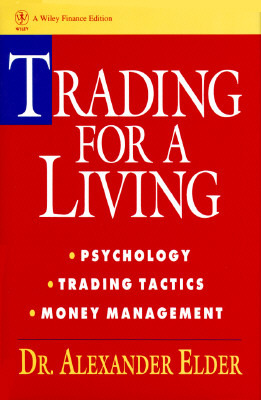
If Not Win Rate, Then What? Building Mental Fortitude with Dr. Alexander Elder
Once the illusion of the high win rate is shattered, an investor is left with a critical void: “If not that, then what metrics and principles should guide my decisions?” Dr. Alexander Elder, a professional psychiatrist who became a successful trader, provides the answer. He brought a clinical understanding of human psychology to the markets, arguing that success stands on three pillars, his famous Three M’s: Mind, Method, and Money. This framework is the perfect blueprint for an intelligent copy trader.
The First M: Mind (Psychology)
- Conquer Emotions: Successful trading is an intellectual and emotional battle. The most successful traders are unemotional and calculating, viewing the market with calm rationality. They do not feel euphoric after a string of wins or despondent after a loss. An investor must recognize that they are competing against some of the world’s brightest minds, and their own emotions of fear and greed are their most dangerous adversaries.
- Accept Full Responsibility: Even when copying another trader, the ultimate responsibility for every decision lies with the investor. Blaming a signal provider for a loss is an abdication of duty. The investor’s job is not to blindly follow but to perform due diligence, select traders wisely, and manage their own capital risk.
- Treat Trading as a Business: Trading is not a casino or a get-rich-quick scheme. It is a serious business that demands a plan, diligent homework, and disciplined execution. The primary goal for any serious market participant should be long-term survival, followed by the steady growth of capital. High profits are a byproduct of a sound process, not the primary objective.
The Second M: Method (Trading System)
- Develop a System with an Edge: For a copy trader, the “edge” is not in analyzing charts but in the ability to select skilled signal providers and manage a portfolio of them effectively. This requires creating a clear, repeatable process for evaluating traders based on robust metrics, not just a superficial glance at a leaderboard.
- Keep Meticulous Records: A trading journal is non-negotiable, even for a copy trader. An investor should document why they chose to copy a specific trader, their performance expectations, and the results over time. This practice turns raw experience into learned wisdom and helps identify personal biases or repeating patterns of success and failure in the selection process.
- Trade with the Trend: Elder, echoing Livermore, emphasizes the importance of aligning with the market’s primary trend. When evaluating a signal provider, a key question is: “What is their core strategy, trend-following, counter-trend, or range-bound? Does this strategy fit the current market environment?”
The Third M: Money (Risk Management)
- The 2% Rule is a Lifeline: A cardinal rule of money management is to never risk more than 2% of total trading capital on any single trade. For a copy trader, this principle must be adapted. It means allocating capital in such a way that a single trader having a disastrous day or week cannot inflict a devastating blow to the entire portfolio.
- The 6% Rule Prevents a Death Spiral: Elder advises that if total account equity falls by 6% from its start-of-month value, all trading should cease for the remainder of that month. This acts as a circuit breaker, forcing a pause to re-evaluate traders and strategy. It is a powerful tool to prevent a string of losses from becoming a catastrophic account blow-up.
- Never Add to a Losing Position: Averaging down, or adding more money to a losing trade, is a classic beginner’s mistake that can turn a small, manageable loss into a portfolio-crippling disaster. It is crucial for a copy trader to investigate whether a signal provider they are considering employs this high-risk tactic.
- Focus on the Process, Not the Money: An investor should not obsessively watch the dollar value of their account fluctuate. The focus should be on the process: Is the copied trader adhering to their stated strategy with discipline? Are they managing risk effectively? Profits are the outcome of a well-executed, professional process.
Frequently Asked Questions (FAQ)
Q1: Is copy trading guaranteed to be profitable?
A: Absolutely not. No form of trading or investment guarantees profit. Copy trading carries significant market risk, and it is possible to lose money. Success is contingent on diligent trader selection, robust personal risk management, and consistent portfolio monitoring. The past performance of any trader is not a reliable indicator of their future results.
Q2: What is a “good” maximum drawdown (MDD) percentage?
A: The definition of a “good” MDD is entirely dependent on an individual’s personal risk tolerance. A conservative investor might seek traders with a historical MDD under 15%. A more aggressive investor, in pursuit of higher returns, might be comfortable with an MDD in the 25-30% range. A drawdown exceeding 40% is generally considered extremely high risk for most retail investors. The essential principle is to ensure that the potential reward adequately justifies the historical risk taken.
Q3: How much capital is needed to start copy trading?
A: While many platforms permit opening an account with a few hundred dollars, effective risk management through diversification requires more substantial capital. To properly diversify by copying 3-5 different traders, a starting capital in the range of $1,000 to $2,000 is more practical. It is imperative to never invest money that one cannot afford to lose.
Q4: Can an investor lose more than their initial investment?
A: With most reputable, regulated forex brokers that provide negative balance protection, an investor cannot lose more than the funds deposited in their account. However, when trading with an unregulated broker or using extreme levels of leverage without this protection, it is theoretically possible to incur a negative balance. It is critical to always use a well-regulated platform.
Q5: What’s more important than a high win rate?
A: Several performance metrics are far more important for evaluating a trader than their win rate:
- Profit Factor: This is the ratio of gross profits to gross losses. A value above 1.5 is considered good, and above 2.0 is excellent. It directly measures if wins are larger than losses.
- Maximum Drawdown (MDD): This reveals the largest peak-to-trough decline in a trader’s equity, serving as a historical indicator of the maximum pain or risk the strategy has endured.
- Risk-Adjusted Return (e.g., Sharpe Ratio): This metric measures a strategy’s return in relation to the risk it has taken. A higher Sharpe Ratio indicates better performance for the amount of risk assumed.
- Consistency and Track Record: A long history (12+ months) of steady, consistent returns across various market conditions is infinitely more valuable than a short, spectacular burst of high gains.
(Disclaimer: This article is for informational and educational purposes only. It should not be considered financial advice. Always conduct your own research and consult with a qualified financial advisor before making any investment decisions.
For more detailed insights on developing daily trading routines, risk management, and effective position sizing strategies, explore additional articles on Trading Cup. Our trading experts at ACY and FinLogix are also great resources to guide your journey towards trading excellence.

Discover Our Best Trading Signals
At Tradingcup, you can browse through a selection of signals and review past performance before you decide to copy.
Become A Signal Provider
Share your expertise and become a signal provider so other traders can copy your trades.
Stay tuned to our blog for more trader spotlights and leaderboard updates.
Trading involves risks.
Visit the Tradingcup blog through the link below for more updates: https://www.tradingcup.com/learn
Related Copy Trading blogs:
- Understanding Market Liquidations: Liquidity Sweeps and Runs Explained
- 7 Essential Daily Habits of Successful Traders to Outperform Their Peers
- 10 Strategies You Can Copy off Our Best Copy Traders
- 5 Strategies Every Trader Can Master To Trade Better In A Trading Contest
- 2026 Copy Trading Scams Exposed: How to Spot Fraud
- A Swing Trading Strategy with an 83 Percent Win Rate and Low Drawdowns
- Forex Martingale Strategies Explained, The Good, The Bad and The Ugly
- Pyramiding Trading Tutorial – Pros & Cons & How to Use It