
Dow Jones Copy Trading Review: Why a 14% Return Makes This One of the Smartest Copy Trading Signals?

Peter Pan
JAN 22 2026
Last Updated: January 22, 2026
This article is reviewed annually to reflect the latest market regulations and trends
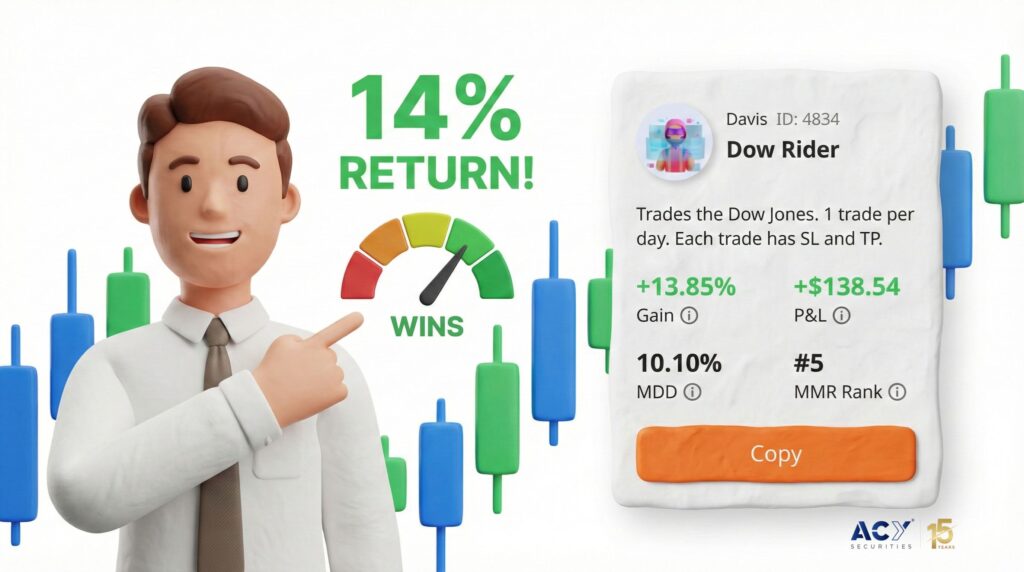
For experts in copy trading, the Dow Rider signal’s true value lies beyond its returns. Here’s why it’s a top choice for a diversified portfolio.
- Disciplined Execution: The strategy is built on a strict “one trade per day” rule on the Dow Jones, with fixed take-profit and stop-loss, making it highly systematic and immune to emotion.
- Focus on Stability: With a modest 14.41% annual return and a maximum drawdown of only 10.1%, this signal prioritizes long-term stability and consistent performance over risky, high-return chasing.
- Core Value in Risk Diversification: By trading the Dow Jones (not forex or gold) in a direction-neutral manner, it provides excellent risk diversification benefits, protecting a copy-trading portfolio from correlated market shocks.
- Ideal for Portfolio Building: This signal is best suited for experienced investors who want to add a low-volatility, complementary asset to their existing strategies, enhancing overall portfolio resilience.
Disclaimer: The information in this article is for educational purposes only and does not constitute financial, investment, or trading advice. Copy trading carries substantial risks, including the potential loss of your entire invested capital. Past performance of copied traders or strategies is not a reliable indicator of future results. You may be replicating high-risk trades, overleveraged positions, or strategies incompatible with your financial goals. Always conduct independent research into a trader’s historical performance, risk metrics, and strategy before copying them. Never invest funds you cannot afford to lose. Consult a licensed financial advisor to ensure copy trading aligns with your risk tolerance, financial objectives, and regulatory requirements in your jurisdiction. This article does not endorse specific traders, platforms, or strategies, and all trading decisions remain your sole responsibility.
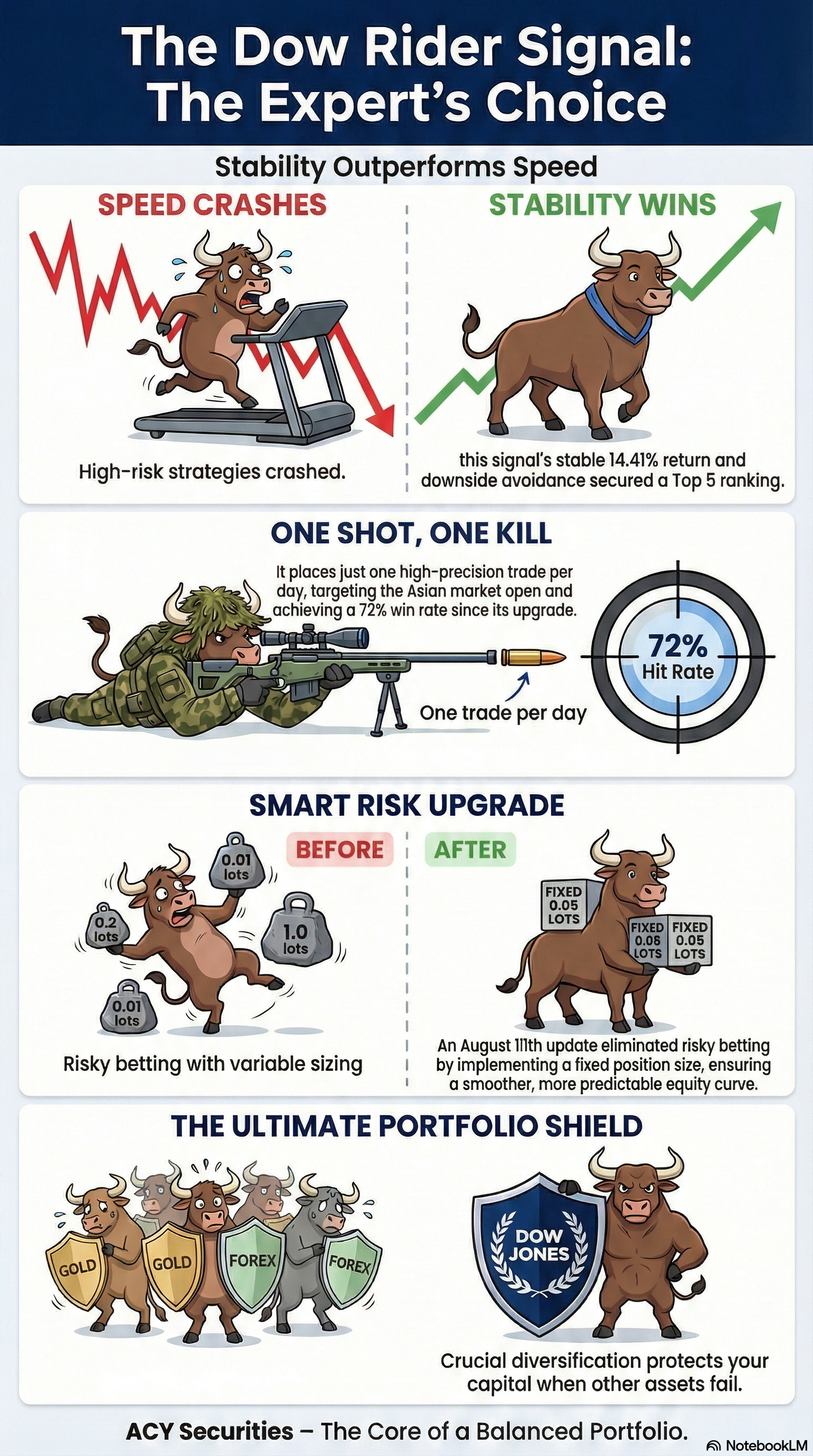

Dow Jones Copy Trading Review: A Super Signal Only Copy Trading Experts Would Choose
If you place just one trade per day and focus on a single instrument, how much can you make in a year?
The answer is 14.41%.
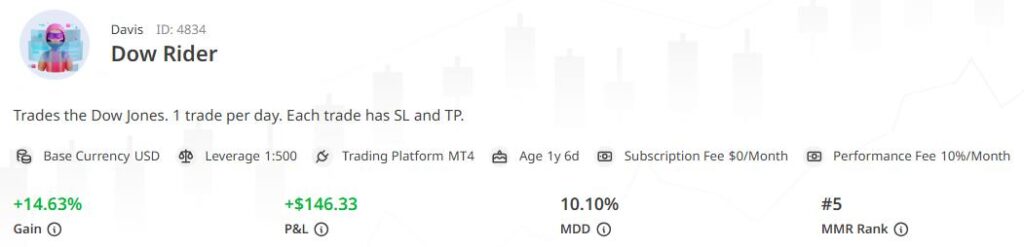
This figure may not sound impressive at first glance, yet it helped trader Davis’s Dow Rider signal break into the Top 5 of the Tradingcup leaderboard in just one year of operation.
Interestingly, the underlying asset it trades the Dow Jones Industrial Average also delivered a return of roughly 14% over the past year.
However, the true value of Dow Rider goes far beyond its headline return.
How Does a 14% Return Signal Reach the Top 5?
Dow Rider Trading Performance
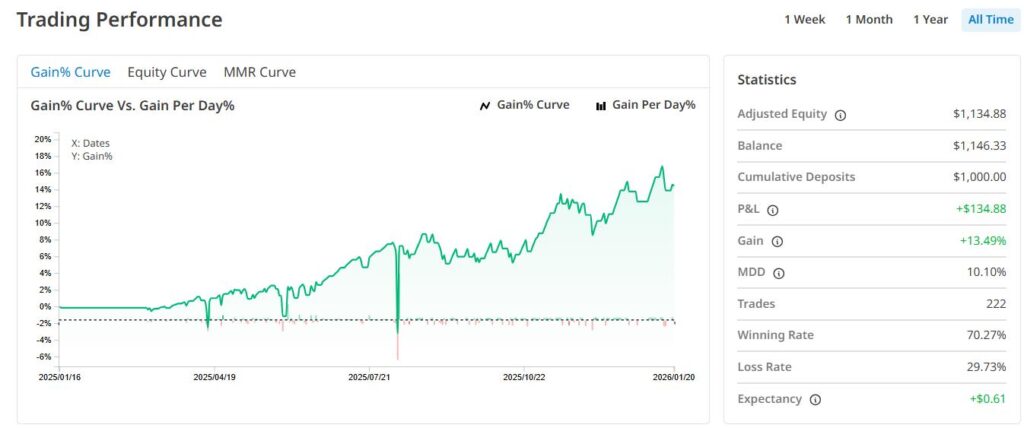
Data as of January 20, 2026
- Total Profit: USD 144.1. With a total deposit of USD 1,000, this corresponds to a total return of 14.41%, which is respectable but not outstanding.
Profit Factor: Approximately 1.24, placing it in the middle range among strong signals on the Tradingcup leaderboard. - Maximum Drawdown: 10.1%. Overall drawdown control is reasonable, although the Calmar ratio is relatively low. That said, compared with the Dow Jones’ drawdown of around 19%, this signal experienced significantly less downside, indicating stronger risk-avoidance capability during extreme market declines (such as the “Trump tariff liberation day”).
- Take Profit & Stop Loss: Every trade is executed with strict take-profit and stop-loss levels. The average take-profit distance is around 9,000 points, while the average stop-loss distance is about 20,000 points, forming a classic small-TP, large-SL structure. Under a random-walk assumption, the theoretical win rate is approximately 69%.
- Actual Win Rate: 70.3%, only 1.3% above the theoretical level.
If only trades after the August 11 position-sizing adjustment are counted, the win rate rises to 72%, around 3% above theory. This suggests that the signal demonstrates a measurable edge in intraday directional judgment, improving entry accuracy beyond randomness. - Long vs Short Trades: The long-to-short ratio is roughly 1:1, indicating no directional bias. Average profit per long trade is 0.69, while average profit per short trade is 0.63. Both sides are consistently profitable, rather than relying solely on the Dow’s long-term inflation-driven uptrend.
If only post-August 11 trades are considered, the average profit per short trade increases significantly to 0.92, highlighting the signal’s ability to identify and capitalize on Dow Jones declines an ability many long-term buy-and-hold strategies lack. - Holding Time: The vast majority of trades are closed intraday, with an average holding time of approximately 9 hours. Only a small number of positions are held overnight, and none for longer than one day. A key advantage is that long positions generally avoid overnight financing costs, improving overall profitability. In addition, trades are typically opened after the Asian market opens, reducing exposure to opening gaps.
What Happened After the August 11th Strategy Optimization?
After August 11: A Major Strategy Optimization
The signal’s maximum drawdown of 10% occurred within a single day (August 7, 2025). Although losses were recovered quickly, the trader had increased position size to 1 lot, clearly reflecting a rebound-betting approach. While this trade did not cause lasting damage to the equity curve, the risk exposure it revealed cannot be ignored. It also highlighted a previous reliance on overnight and proportional position-scaling methods that amplified risk.

Following this drawdown, starting on August 11, the signal implemented a clear position-sizing overhaul, abandoning proportional scaling and mean-reversion betting. From that point onward, the strategy placed only one trade per day, with position size fixed at 0.05, gradually increasing to 0.07 once stability was confirmed.
This adjustment significantly improved overall stability, producing a smoother and more controllable equity curve. At the same time, key metrics such as win rate and average profit per trade showed noticeable improvement.
Why is Risk Diversification Its Rarest and Most Valuable Quality?
The Rarest Quality of the Dow Rider Signal
Even after the position-sizing upgrade, a 14.41% return still struggles to attract most copy traders at first glance. From a purely results-driven perspective, this is not the kind of signal that immediately triggers a “must-follow” reaction.
So why spend so much time analyzing a signal that appears, on the surface, rather ordinary?
Because it possesses a set of critical characteristics that are rare even among high-quality signals, especially within copy-trading portfolios.
Its most important value lies in risk diversification.

In real markets, forex, equities, and commodities often move together. For example, during periods of strong USD appreciation, gold, US equities, and the Australian dollar may all decline simultaneously, amplifying portfolio drawdowns.
In copy trading, this risk is often underestimated, as investors naturally gravitate toward signals with similar logic and style. When unexpected market events occur, multiple signals can fail at once, magnifying losses at the portfolio level.
It is precisely in this context that Dow Rider’s strengths stand out.
First, it trades the Dow Jones index.
While most signals focus on forex or gold, the Dow Jones inherently provides diversification benefits. Compared with the S&P 500 and Nasdaq, the Dow has lower weightings in high-volatility growth stocks, and market sentiment tends to be reflected more moderately. When combined with other high-quality copy-trading strategies, it helps reduce dependence on any single asset or trading logic.
Second, it is direction-neutral.
With a near-equal balance of long and short trades and similar profitability on both sides, expected returns are not dependent on a long-term equity uptrend. If the market enters a sharp correction or even a bear phase, the strategy is unlikely to suffer systemic damage and may even provide hedging value as part of a long-term allocation.
Third, its rules are highly standardized and largely immune to emotion.
One trade per day, balanced long and short exposure, minimal overnight holding, and strict take-profit and stop-loss rules with fixed distances. This structure shows that the strategy does not rely on discretionary judgment or momentary conviction. No matter how confident the market view, take-profit targets are not widened; no matter how severe a loss, positions are exited immediately at stop-loss.
This level of rule-based execution helps avoid emotion-driven short squeezes or panic sell-offs. For example, during sharp equity market sell-offs, many traders fall into forced liquidation or aggressive bottom-fishing, whereas Dow Rider maintains its trading rhythm without blindly adding against the trend or being dragged by market emotion.
In one sentence:
The true value of Dow Rider lies in its ability to diversify risk within a copy-trading portfolio.
Who Is This Dow Jones Signal Suitable For (and What are the Risks)?
- Investors seeking diversification and reduced portfolio volatility
- Those already following forex or gold strategies who need a complementary allocation
- Traders who prioritize stability over short-term high returns
Why diversify copy trading, and what are the risks of following only one signal? Click here to learn more.
Risks to Consider When Copy Trading This Signal
- After the position-sizing adjustment, the live track record spans only about five months. With one trade per day, the sample size is just over one hundred trades, which may not yet fully demonstrate performance under extreme market conditions.
- A 10% performance fee directly reduces net returns, bringing the expected annual return after fees to around 13%.
Overall, these concerns are more about cautious scrutiny than structural flaws. In terms of discipline, stability, and diversification value, the strategy remains one where the strengths outweigh the weaknesses.
Conclusion
Dow Rider is not a signal that relies on luck or aggressive risk-taking. Instead, it is one of the rare strategies that places risk diversification, disciplined execution, and long-term stability at the core of its design. Within a copy-trading ecosystem, such signals are often more scarce and more valuable than high-return strategies.
If your goal is to build a more resilient, lower-volatility portfolio, now is an appropriate time to include Dow Rider in your Tradingcup copy-trading allocation as a core diversification component.
Looking for the Best Copy Trading Strategy?
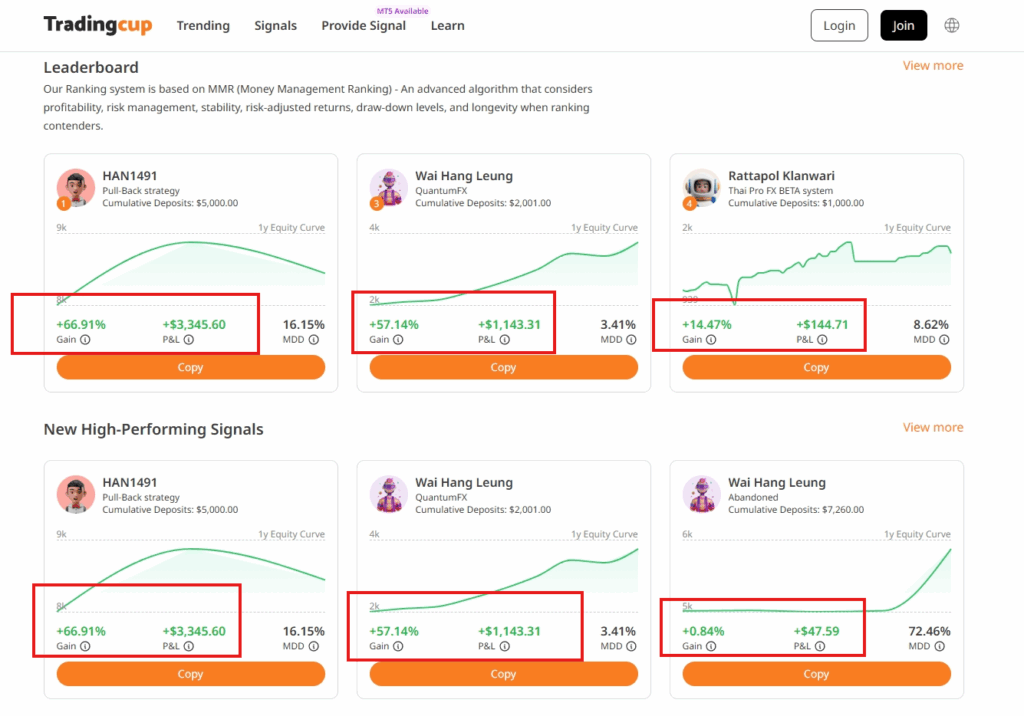
We’ve compiled a leaderboard of the most outstanding traders with excellent drawdown control and clear trading styles. This way, you’ll never feel lost when choosing who to follow and won’t blindly chase trends. Click to view the latest trader rankings and find out who is truly worth copying! Choose the right person, copy the right strategy, and from today, let copy trading truly create value for you.
Bonus Guide
What Makes an Effective Trading Portfolio?
- Diversification: Spread funds across various asset types (e.g., stocks, bonds, real estate, cash, precious metals) and industries/regions to reduce exposure to single-market volatility.
- Asset Allocation: Tailor allocations based on your risk tolerance, goals, and time horizon. Conservative portfolios emphasize fixed income, while aggressive ones lean into equities.
- Risk-Reward Balance: Each asset has different risk/return profiles. Ensure your portfolio avoids excessive exposure to high-risk or low-return assets.
- Low Correlation: Combine assets with correlations below 0.3 to enhance stability and provide a cushioning effect during market swings.
- Dynamic Rebalancing: Review and adjust your portfolio regularly as markets or personal goals change to stay aligned with your risk-return expectations.
- Clear Objectives: Define your financial goals (retirement, housing, education) before designing your strategy and time horizon.
- Discipline & Logic: Stick to your trading plan without emotional decision-making. Regularly reassess assumptions and market conditions.
(Disclaimer: This article is for informational and educational purposes only. It should not be considered financial advice. Always conduct your own research and consult with a qualified financial advisor before making any trading decisions.
For more detailed insights on developing daily trading routines, risk management, and effective position sizing strategies, explore additional articles on Trading Cup. Our trading experts at ACY and FinLogix are also great resources to guide your journey towards trading excellence.

Discover Our Best Trading Signals
At Tradingcup, you can browse through a selection of signals and review past performance before you decide to copy.
Become A Signal Provider
Share your expertise and become a signal provider so other traders can copy your trades.
Stay tuned to our blog for more trader spotlights and leaderboard updates.
Trading involves risks.
Visit the Tradingcup blog through the link below for more updates: https://www.tradingcup.com/learn
Related Copy Trading blogs:
- Understanding Market Liquidations: Liquidity Sweeps and Runs Explained
- 7 Essential Daily Habits of Successful Traders to Outperform Their Peers
- 10 Strategies You Can Copy off Our Best Copy Traders
- 5 Strategies Every Trader Can Master To Trade Better In A Trading Contest
- 2025 Copy Trading Scams Exposed: How to Spot Fraud
- A Swing Trading Strategy with an 83 Percent Win Rate and Low Drawdowns
- Forex Martingale Strategies Explained, The Good, The Bad and The Ugly
- Pyramiding Trading Tutorial – Pros & Cons & How to Use It