
AI Trading VS Copy Trading

TradingCup
MAR 17 2025
Last Updated: March 17, 2025
This article is reviewed annually to reflect the latest market regulations and trends.
“If you want to go fast, go alone; if you want to go far, go together.” – African Proverb
TLDR Summary: AI trading uses advanced algorithms to execute trades with speed and precision, while copy trading allows you to mirror experienced traders. This guide explores both methods, comparing their benefits, risks, and strategic approaches to help you choose the best path for your financial goals.
AI Trading vs Copy Trading: Key Differences
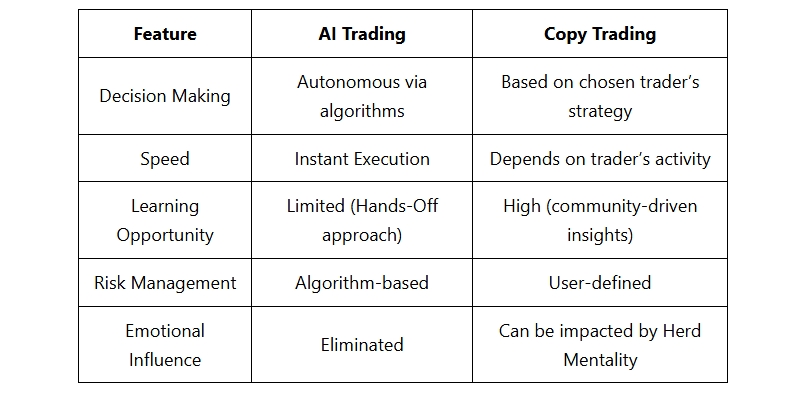
While both AI trading and copy trading leverage technology to simplify trading, their approaches differ significantly. Here’s a detailed comparison to help you understand which method suits your needs:
- Decision-Making
- AI Trading: Autonomous algorithms analyse data and execute trades based on predefined rules, offering a hands-off approach.
- Copy Trading: Decisions stem from replicating a selected trader’s strategy, relying on their expertise rather than automation alone.
- Execution Speed
- AI Trading: Trades are executed instantly, often within milliseconds, capitalising on rapid market shifts.
- Copy Trading: Execution depends on the master trader’s actions, which may introduce slight delays.
- Learning Opportunity
- AI Trading: Limited direct learning, as the process is automated and opaque without technical expertise.
- Copy Trading: High educational value, with visibility into master traders’ strategies fostering skill development.
- Risk Management
- AI Trading: Risk is controlled through algorithm settings, such as stop-loss limits, though these are predefined.
- Copy Trading: Users define their own risk parameters, offering flexibility to adjust exposure and protect capital.
- Emotional Influence
- AI Trading: No emotional interference, ensuring consistent, logic-based decisions.
- Copy Trading: Subject to the master trader’s emotions, which could impact performance if not disciplined.
A Strategic Approach Used by Seasoned Traders
Experienced traders often find that the true power of trading lies not in choosing one method over another, but in blending technology with personal expertise. This hybrid approach maximises efficiency while retaining the human insight needed to navigate complex markets. Some copy traders use Martingale strategies, which involve doubling trade sizes after losses. AI-driven copy trading may offer alternative risk-controlled approaches.
One seasoned trader explains their method:
“I use a combination of AI agents and LLMs to do all of my initial data collection, analysis, generate my watchlist, and even give me trade ideas for tickers on my watchlist. But it’s my experience and knowledge that allows me to leverage the info it provides.”
Reddit Discussion
This perspective underscores a critical truth: while AI excels at processing data and identifying opportunities, it’s the trader’s judgement that refines these insights into winning strategies.
How It Works in Practice
AI agents can scan thousands of stocks, using technical indicators to flag potential trades, while large language models (LLMs) analyse news and sentiment to provide context. This creates a robust foundation a watchlist of high-potential assets and data-backed trade ideas.
However, the trader steps in to evaluate these suggestions against broader factors, such as macroeconomic trends or company fundamentals, that AI might not fully capture. Their experience also guides timing and risk management, ensuring trades align with market conditions.
This strategic blend allows traders to harness AI-driven decision-making in finance while maintaining control over the final execution. It’s a balanced approach that adapts to both volatile and stable markets, offering a model for success on platforms like ACY.
The Evolving Landscape of Trading
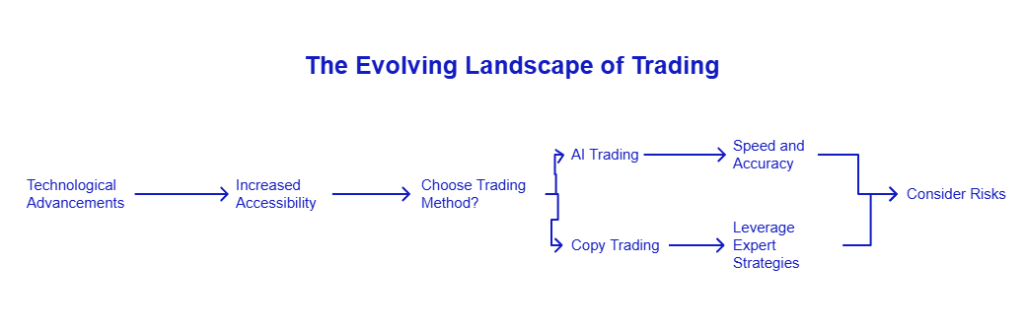
The financial markets are evolving at an unprecedented pace, propelled by technological advancements that are reshaping how traders engage with opportunities. From online platforms to mobile applications, technology has made trading more accessible than ever before.
Two standout innovations in this space are AI trading and copy trading methods that harness automation and expertise in unique ways to enhance trading outcomes.
AI trading employs cutting-edge algorithms and machine learning to analyse market data, predict trends, and execute trades autonomously. It’s a method that thrives on speed, accuracy, and the removal of human emotion from decision-making. On the other hand, copy trading offers a collaborative approach, enabling traders to automatically replicate the strategies of seasoned investors. It’s particularly appealing to beginners or those seeking to leverage the knowledge of others without dedicating extensive time to market analysis.
Both methods present distinct advantages, but they also come with their own risks and considerations. Your choice between AI trading and copy trading will depend on your goals, experience level, and risk tolerance.
Understanding AI Trading
AI trading, or artificial intelligence trading, involves the use of sophisticated algorithms and machine learning to process vast amounts of market data, identify patterns, and execute trades automatically. These systems are designed to operate at speeds and scales beyond human capability, making them a powerful tool for traders seeking data-driven precision.
How AI Trading Works
At its core, AI trading relies on machine learning models trained on historical market data. These models learn to recognise patterns such as price movements tied to specific technical indicators and apply that knowledge to real-time scenarios.
Beyond price data, advanced AI systems incorporate natural language processing (NLP) to analyse news, earnings reports, and social media for sentiment insights, further refining their predictions.
Key Benefits of AI Trading
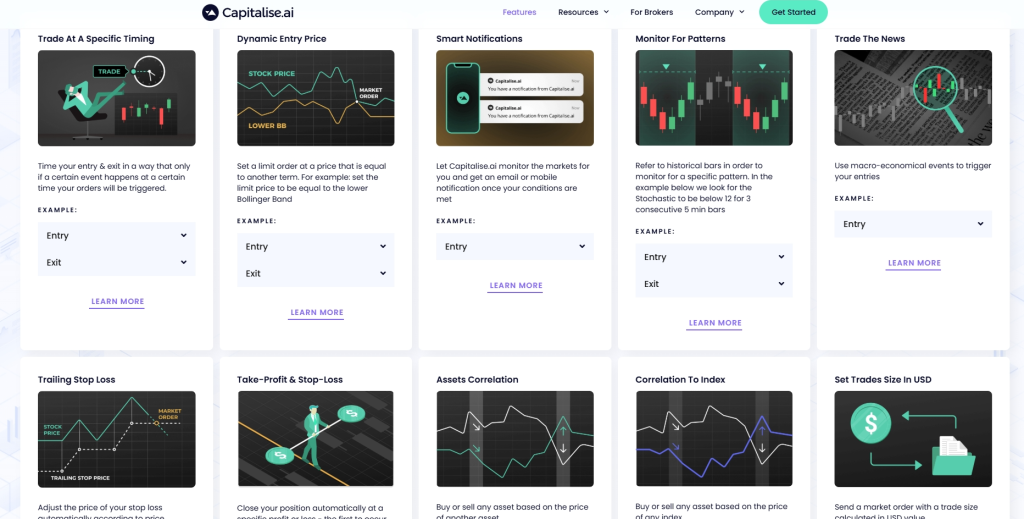
- Increased Accuracy: By analysing historical and real-time data comprehensively, AI can detect subtle trends and correlations that human traders might overlook, leading to more precise trade decisions.
- Real-Time Efficiency: AI systems operate 24/7, executing trades in milliseconds to capitalise on fleeting market opportunities.
- Scalability: Capable of monitoring multiple markets and asset classes simultaneously, AI supports diversified trading strategies with ease.
- Elimination of Emotional Biases: Free from fear, greed, or hesitation, AI ensures decisions are based solely on data and predefined rules.
AI trading is ideal for those who value automation and efficiency, making it a popular choice among tech-savvy traders.
What is Copy Trading?
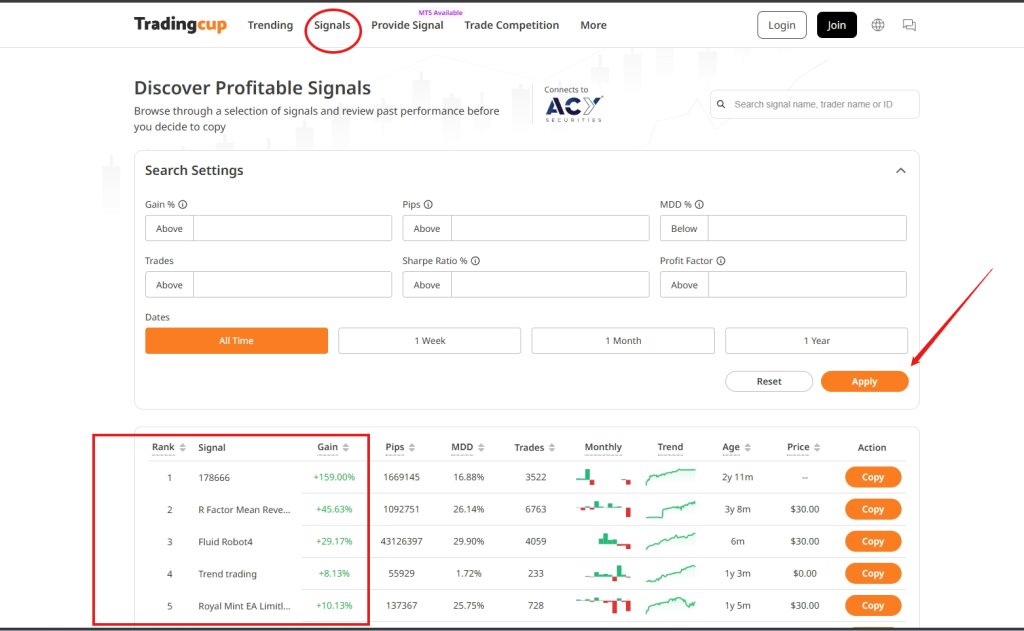
Copy trading is a method where traders automatically replicate the trades of experienced investors, often called signal providers or master traders. This approach leverages the expertise of others, making it an attractive option for beginners or those with limited time to dedicate to market analysis.
How Copy Trading Works
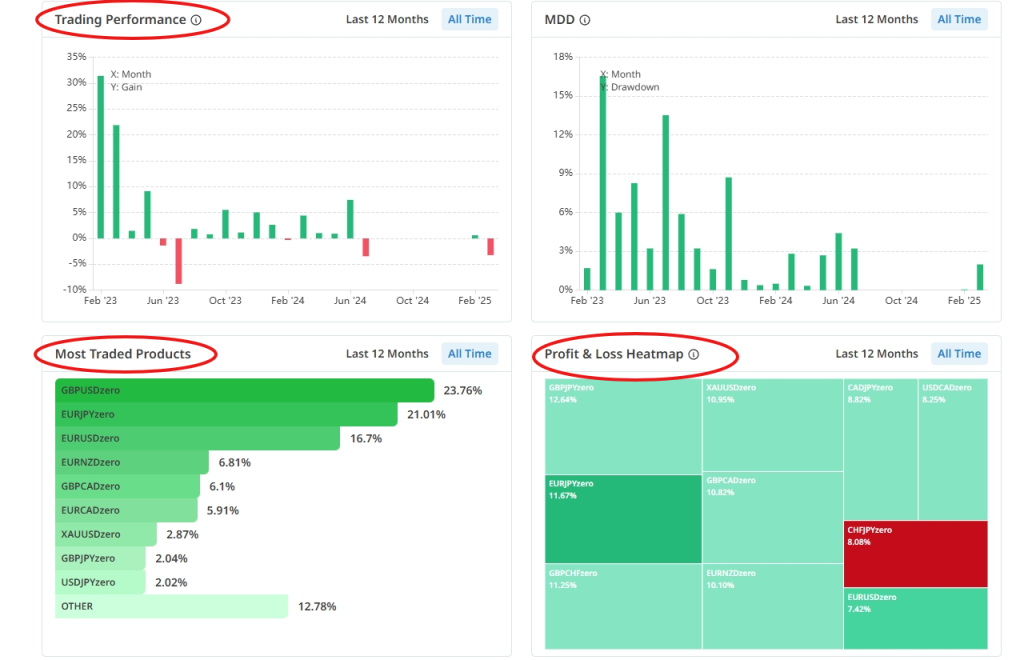
On copy trading platforms, users select master traders to follow based on performance metrics, risk levels, and trading styles. Once chosen, every trade the master trader executes, whether opening or closing a position, is mirrored in the copier’s account, proportional to their allocated funds.
Key Benefits of Copy Trading
- Ease of Use: Intuitive interfaces make copy trading accessible, requiring little prior knowledge to get started.
- Community Engagement: Social trading platforms encourage interaction, allowing users to discuss strategies and learn from peers.
- Customisation Options: Traders can choose whom to copy, adjust risk settings, and allocate funds to align with their personal goals.
Copy trading bridges the gap between novice and expert traders, offering a practical entry point into the markets.
Actionable Strategies for Both Methods
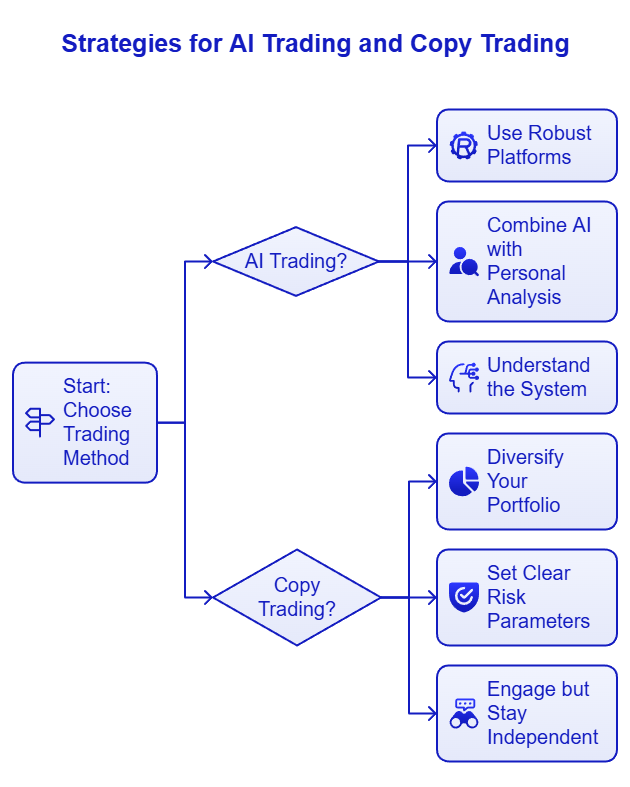
Whether you lean towards AI trading or copy trading, implementing the right strategies can enhance your results. Here’s how to make the most of each method:
For AI Trading
- Use Robust Platforms: Opt for platforms with proven machine learning capabilities, such as those offered by TradingCup. Regularly monitor algorithm performance and adjust settings to match market conditions.
- Combine AI with Personal Analysis: Treat AI insights as a starting point. Cross-check trade ideas with your research, such as industry news or economic reports, to capture trends algorithms might miss.
- Understand the System: Learn the basics of how your AI platform operates to build confidence in its outputs and make informed tweaks when needed.
For Copy Trading
- Diversify Your Portfolio: Follow multiple traders with varied styles to spread risk and stabilise returns. Learn more about this approach at diversify-copy-trading.
- Set Clear Risk Parameters: Use stop-loss orders and define your risk tolerance upfront. Review master trader performance monthly to ensure alignment with your goals.
- Engage but Stay Independent: Participate in social trading communities on platforms like ACY for insights, but evaluate strategies critically to avoid herd mentality.

Conclusion
AI trading and copy trading each offer compelling pathways to success in the financial markets, tailored to different trader profiles. AI trading delivers speed, precision, and emotional neutrality perfect for those who prioritise automation and efficiency.
Copy trading, with its accessibility and educational value, suits beginners or those who thrive on community collaboration.
Yet, as seasoned traders demonstrate, the most effective approach often combines the strengths of both. By leveraging artificial intelligence in trading for data analysis and trade generation, and applying personal expertise to refine those ideas, you can build a strategy that’s both powerful and adaptable.
Your decision hinges on your trading style, risk tolerance, and learning preferences. Assess these factors carefully to determine which method or combination best supports your financial ambitions.
For more detailed insights on developing daily trading routines, risk management, and effective position sizing strategies, explore additional articles on Trading Cup. Our trading experts at ACY and FinLogix are also great resources to guide your journey towards trading excellence.

Discover Our Best Trading Signals
At Tradingcup, you can browse through a selection of signals and review past performance before you decide to copy.
Become A Signal Provider
Share your expertise and become a signal provider so other traders can copy your trades.
Stay tuned to our blog for more trader spotlights and leaderboard updates.
Trading involves risks.
Visit the Tradingcup blog through the link below for more updates: https://www.tradingcup.com/learn
For further reading, visit acy.com