
Gold Copy Trading: XAUUSD Analysis Today

TradingCup
JUL 02 2025
Last Updated: July 02, 2025
This article is reviewed annually to reflect the latest market regulations and trends.
Disclaimer: The information in this article is for educational purposes only and does not constitute financial, investment, or trading advice. Copy trading carries substantial risks, including the potential loss of your entire invested capital. Past performance of copied traders or strategies is not a reliable indicator of future results. You may be replicating high-risk trades, overleveraged positions, or strategies incompatible with your financial goals. Always conduct independent research into a trader’s historical performance, risk metrics, and strategy before copying them. Never invest funds you cannot afford to lose. Consult a licensed financial advisor to ensure copy trading aligns with your risk tolerance, financial objectives, and regulatory requirements in your jurisdiction. This article does not endorse specific traders, platforms, or strategies, and all trading decisions remain your sole responsibility.
TL;DR: (Too Long, Didn’t Read)
- To make your trading journey grand,
- First, study the lay of the land.
- With a plan and less greed,
- You’re more likely to succeed.
- Keep your risks and your leverage in hand,
- And your account may grow as you’d planned.
“Wealth is the slave of a wise man. The master of a fool.” – Seneca
Gold Copy Trading Unlocked: Your 2026 Guide to XAUUSD
You’re busy. Life, work, and a million other things demand your attention. You’ve heard about investing and the potential of financial markets, but the idea of spending years learning complex charts and economic theories feels impossible. Then you discover forex, a vibrant 24-hour market, and within it, a seeming shortcut: copy trading.
The promise is intoxicating: just find a successful trader, click “copy,” and watch your account grow. You see the incredible returns of top gold (XAUUSD) traders and think, “This is it. This is the solution.”
But should you? Is it truly that simple to copy top gold traders and profit from one of an asset as notoriously volatile and complex as gold?
This guide is built on a deep, institutional-level analysis of the XAUUSD market. It’s designed to shift your perspective from that of a passive “follower” to a savvy “portfolio manager.” We will equip you with the tools, frameworks, and critical mindset needed to make smarter decisions on your forex journey, especially when starting with copy trading.
What Exactly is Gold Copy Trading?
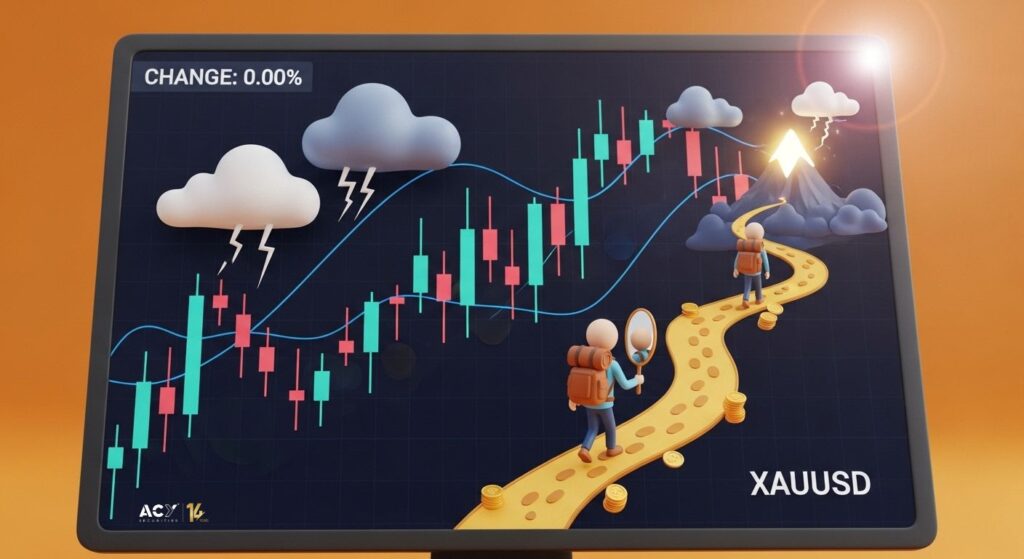
At its core, gold copy trading is a technology that allows you to automatically replicate the trades of an experienced investor in your own account. When they buy or sell gold (XAUUSD), your account does the same in proportion to the capital you’ve allocated. It’s a way to access the financial markets without having to perform the complex analysis or manual execution for every trade yourself.
Is Copy Trading a Perfect Path for Beginners?

Copy trading isn’t for everyone. Before you jump in, consider this checklist:
- Are you comfortable with risk? All trading involves risk, and past performance is not indicative of future results. Even the best traders have losing streaks.
- Do you have capital you can afford to lose? Never invest money you can’t afford to part with.
- Are you looking for a passive investment? While copy trading is less hands-on, it still requires initial research and ongoing monitoring.
- Do you understand the fee structures? Subscription fees and performance fees can eat into profits.
- Are you patient? Quick riches are rare. Successful trading, even copying, often requires a long-term perspective.
- Are you willing to do your due diligence? Selecting a trader requires careful analysis of their history, strategy, and risk management.
- Do you have realistic expectations? Don’t expect to double your money overnight.
- Are you emotionally prepared for drawdowns? Seeing your account balance dip, even temporarily, can be stressful. Maximum Drawdown (MDD) is a key metric to understand.
If you’ve nodded along to these points with a clear understanding, then XAUUSD copy trading might be a suitable avenue for you to explore.
The XAUUSD Market Landscape in 2026: What’s Driving the Price of Gold?
To pick the right trader, you must first understand the sea they are sailing. The gold market of 2026 is not random; it is shaped by powerful macroeconomic forces and punctuated by sharp, sentiment-driven volatility.
The Fundamental Case: A Bullish Backdrop
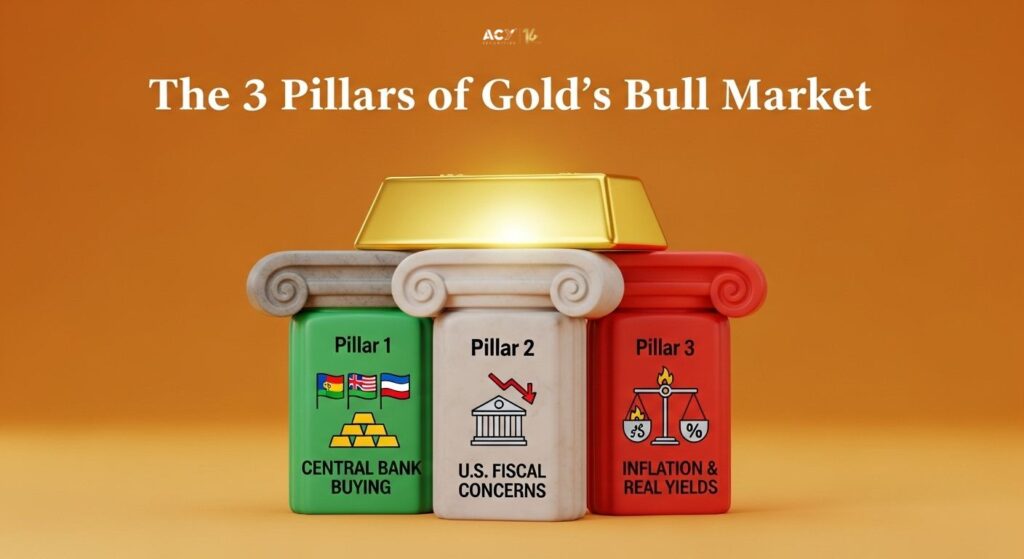
Several deep-rooted trends are creating a strong, long-term case for gold:
- De-Dollarization and Central Bank Buying: Global central banks (CBs) are strategically moving away from the U.S. dollar and are relentlessly buying gold to diversify their reserves. J.P. Morgan forecasts CBs will purchase a staggering 900 tonnes of gold in 2026 alone. This demand is largely insensitive to price, creating a powerful and stable floor under the market. Key buyers include global players like China, Poland, Türkiye, and India.
- U.S. Fiscal Concerns: Soaring U.S. government debt and deficits are eroding long-term confidence in the dollar. With Moody’s forecasting the U.S. deficit to potentially hit 9% of GDP by 2035, gold’s appeal as a non-sovereign, hard store of value is increasing significantly.
- Inflation vs. Interest Rates: The crucial metric for gold is the real yield (interest rates minus inflation). As real yields fall, non-yielding gold becomes more attractive. While the Federal Reserve’s actions can create short-term headwinds, underlying inflation fears provide durable support for the metal.
The Sentiment Case: A Hedge Against Fear
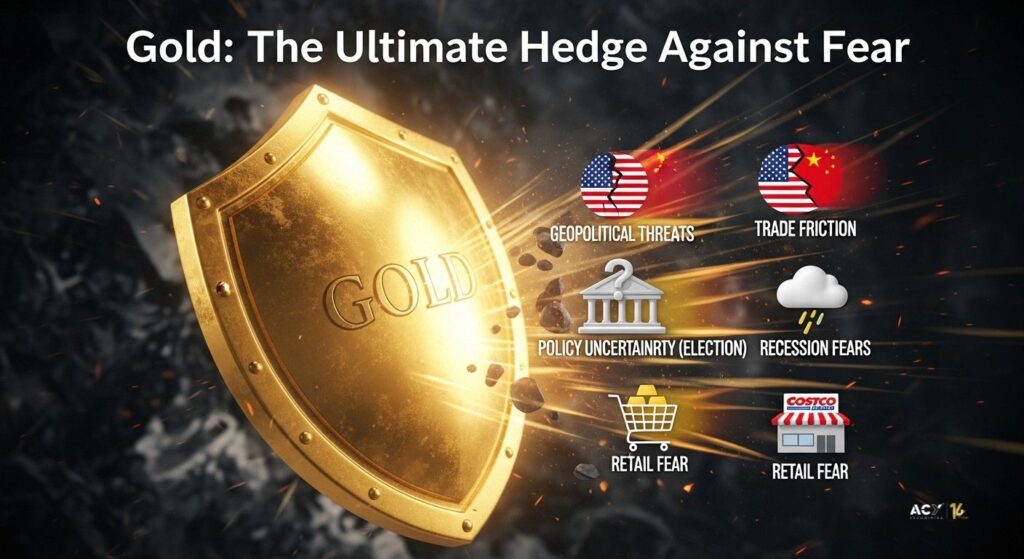
Beyond economics, gold thrives on uncertainty.
- Geopolitical Instability: Unresolved trade frictions and unpredictable U.S. policy create an environment where investors seek safety. This dynamic has been a key reason for gold pushing to new highs in 2025 and is why institutional strategists label gold as an optimal hedge against risks like stagflation and recession.
- Retail-Level Demand: The demand for a safe haven has gone mainstream. Major retailers like Costco and Walmart now selling physical gold signals a broad-based desire for a tangible store of wealth, underpinning institutional sentiment.
What Do These Market Forces Mean for Your Copy Trading Decisions?
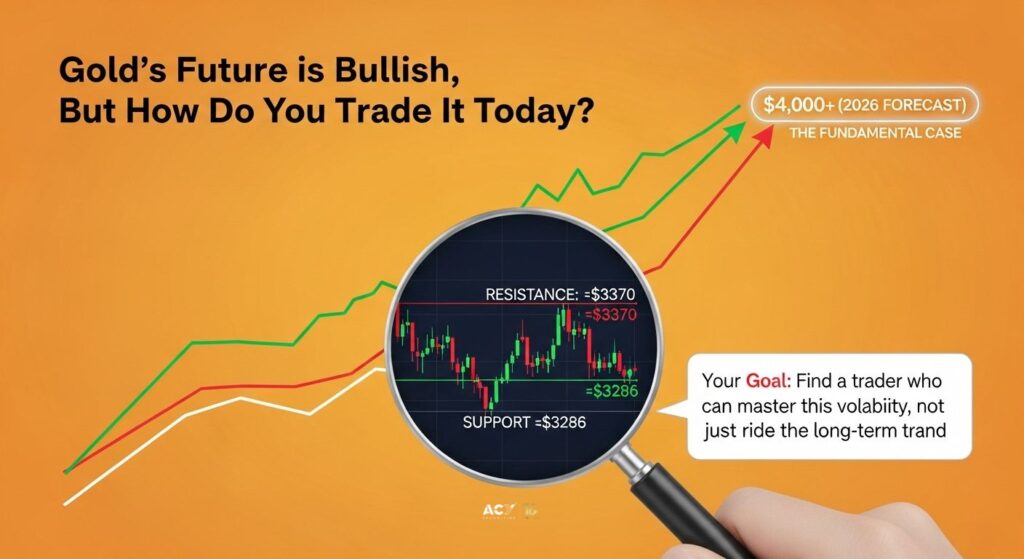
The long-term bullish forecast, with some analysts projecting gold could approach $4,000/oz in 2026 and over $5,900 by 2030, sets the overall stage. However, the traders you will copy are not investing for 2030; they are attempting to profit from the short-term price swings between key technical levels today.
As of mid-2025, gold is in a corrective phase, creating a challenging environment for short-term traders. Their success depends on navigating the volatility between critical support zones (like $3301-$3286 and $3226-$3203) and resistance levels (like $3360-$3370).
Your job is not to find a “gold expert,” but an expert in a specific, short-term trading strategy designed to harvest this volatility.
Who Should You Copy? Identifying Gold Trader Archetypes
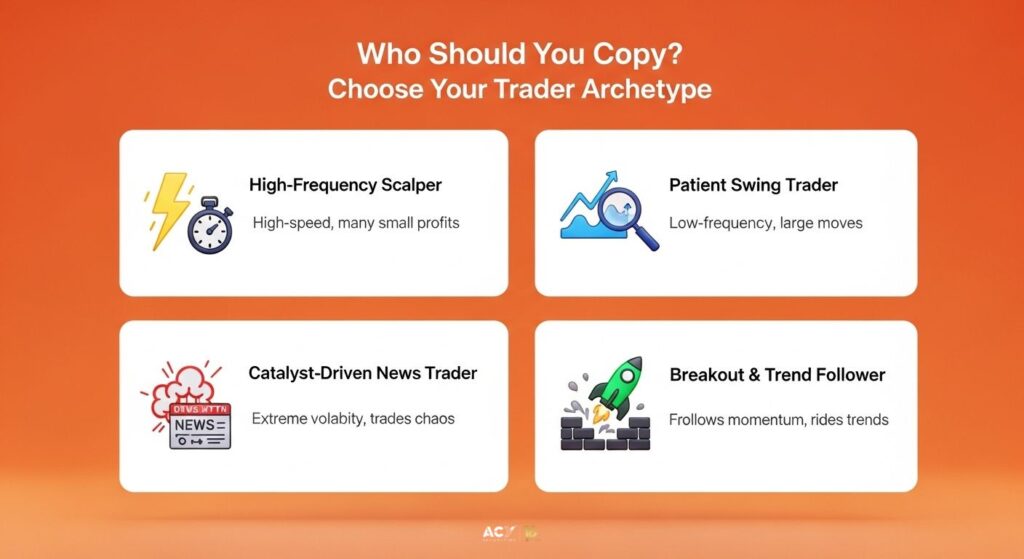
Traders are not all the same. They employ distinct playbooks, and picking the right one, or a combination, is key to aligning with your risk tolerance.
- The High-Frequency Scalper: A master of the immediate, holding trades for minutes to capture dozens of tiny profits. They live on 1-minute charts and rely on speed and low costs. Risk Profile: High win rate, but one large loss can erase many wins. Requires extremely disciplined stop-losses.
- The Patient Swing Trader: In it for the bigger move, holding positions for days or weeks to capture a significant “swing” in the price. They use daily charts and fundamental analysis to identify high-probability setups. Risk Profile: Fewer trades, lower win rate, but much larger average profits. You must be able to endure larger drawdowns while a trade develops.
- The Catalyst-Driven News Trader: An opportunist who trades the chaos of major economic data releases like Fed announcements or inflation reports. Risk Profile: Extreme. Offers potential for massive, rapid gains but comes with equally massive risk due to insane volatility and wide spreads.
- The Breakout/Trend-Following Trader: Identifies established trends or ranges and trades when the price “breaks out” with momentum. They use technical tools like moving averages and volume analysis to confirm their moves. Risk Profile: Highly profitable in clear, trending markets but gets chopped up by “false breakouts” in sideways markets.
A Day in the Life: What Due Diligence in Copy Trading Looks Like
Professional due diligence goes far beyond a trader’s headline ROI. It’s a systematic process of decoding metrics and assessing the person behind the trades.
Your Quantitative Toolkit:
- Maximum Drawdown (MDD): This is the single most important risk metric. It shows the largest percentage loss the trader’s account has suffered from its peak. An MDD of 40% means they have, at some point, lost 40% of their capital. Before you copy, ask yourself: “Could I stomach a 40% loss ($800 on my $2,000 account) without panicking?”. If the answer is no, the trader is unsuitable, no matter the ROI.
- Profit Factor: Calculated as Gross Profit divided by Gross Loss. A value over 1.8 is a strong sign of a robust trading edge, showing that wins consistently outweigh losses.
- Sharpe Ratio: This measures return per unit of risk. A higher Sharpe Ratio is always better, as it indicates a smoother ride with less volatility. A trader with a 30% ROI and 10% MDD is far superior to one with a 50% ROI and 50% MDD.
- Track Record: Look for consistency over a long period, at least 12 months is a good benchmark. A short, meteoric rise could just be unsustainable luck.
Comparative Analysis in Action of Top Gold traders June
Let’s apply this to a real-world example using the TradingCup trader statistics.
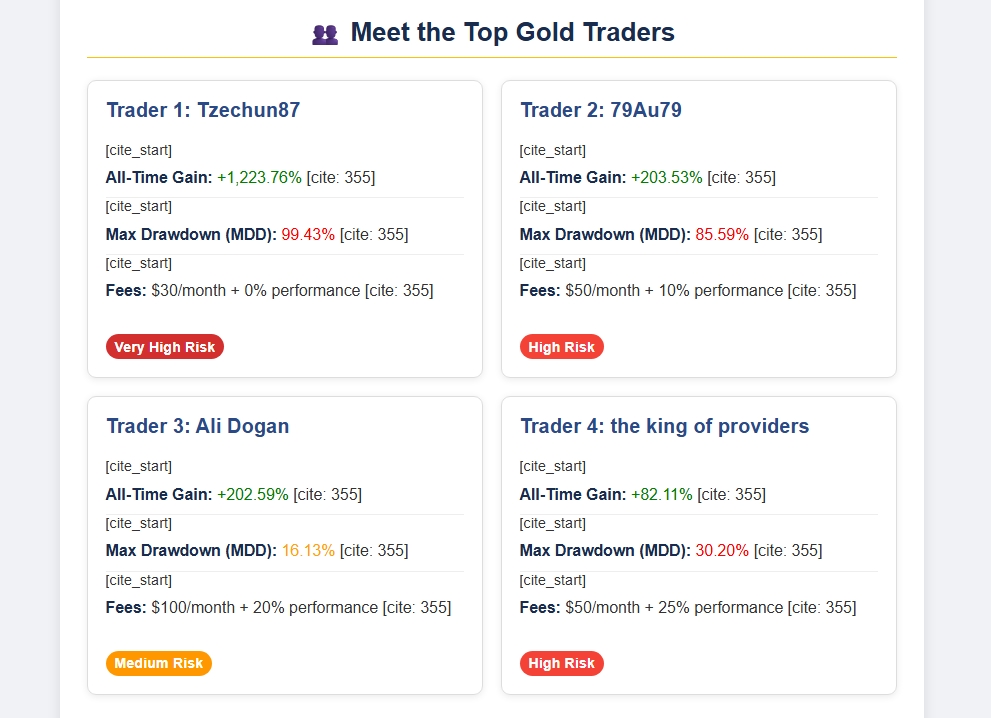
Here’s a detailed look at four popular gold traders, their performance metrics, and what they could mean for your portfolio. The data is based on their performance as of early June 2025.
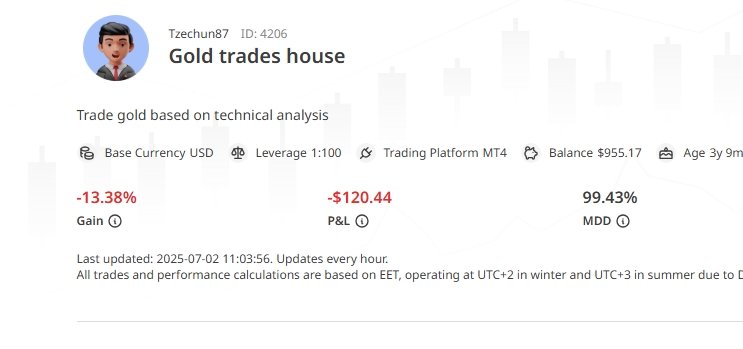
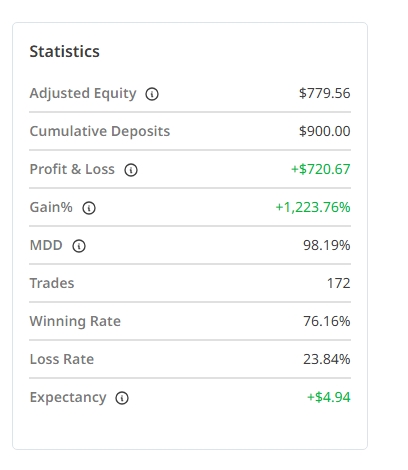
Tzechun87:
A trader with over three and a half years of experience who relies on technical analysis. Gold (XAUUSD) makes up over 90% of their trades.
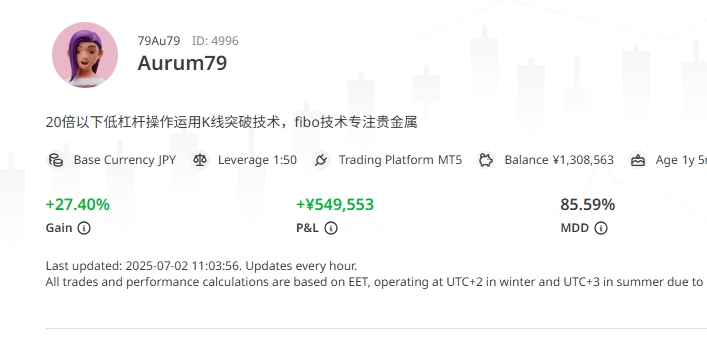
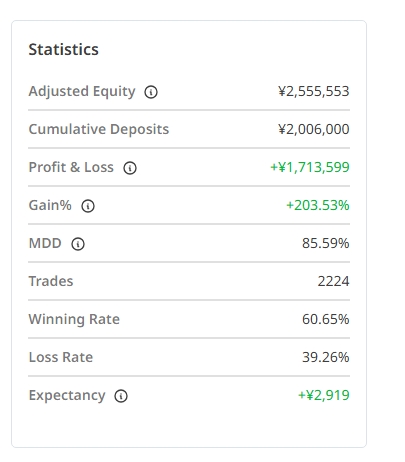
79Au79:
With over a year in the game, this trader uses K-line breakout and Fibonacci techniques, with a strong focus on precious metals. Gold (XAUUSD) constitutes 76.06% of their trading activity.
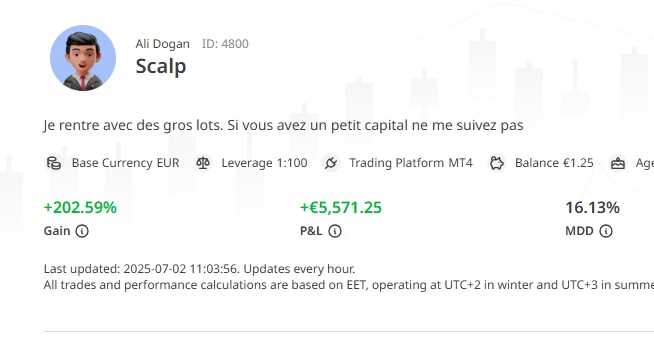
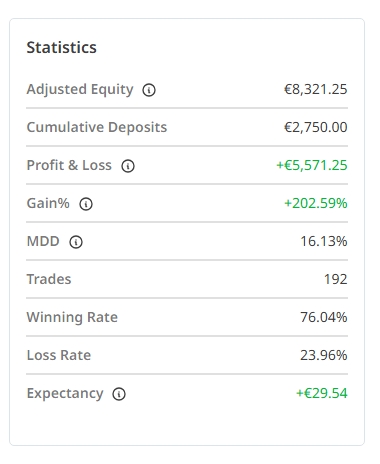
Ali Dogan:
A scalper with six months of trading history who advises that his strategy of using large lots may not be suitable for those with small capital. XAUUSD dominates their portfolio at 95.92%.
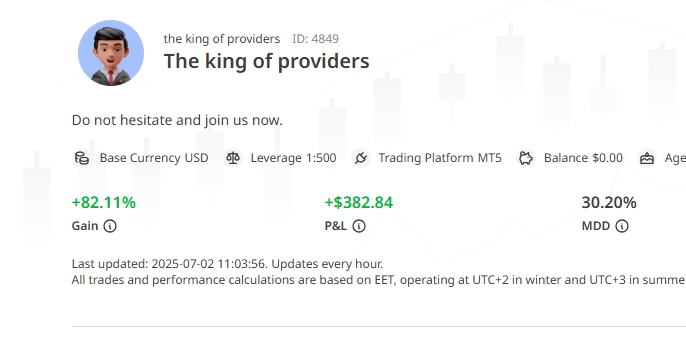
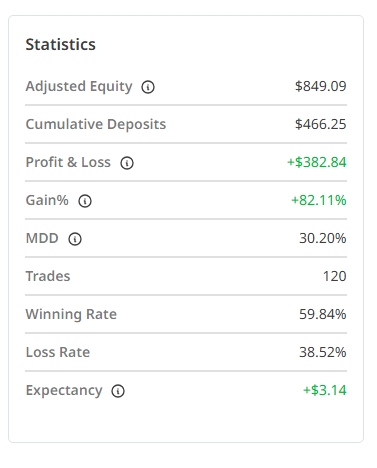
the king of providers:
An experienced trader of over two years who focuses heavily on XAUUSD, which accounts for 98.36% of their trades.
What Nick Leeson’s Downfall Teaches Gold Copy Traders

Nick Leeson, the rogue trader who collapsed Barings Bank, wasn’t a copy trader, but his story is a vital cautionary tale about the exact risks you face. Leeson hid his massive losses in a secret error account, presenting a picture of profitability to his superiors while spiraling deeper into ruin. This is the ultimate
Strategy Provider Risk. When you copy a trader, you are placing blind trust in their reported numbers. Are they disciplined, or are they, like Leeson, doubling down on losses and hiding their mistakes? Are they adhering to their stated strategy, or are they “revenge trading” after a bad day?. Leeson’s downfall wasn’t a single bad trade; it was a complete breakdown in personal discipline and risk management oversight, the very things you must scrutinize in the traders you choose to copy.
Beyond the Charts: 10 Lessons from “Why Gold, Why Now” for the Modern Investor
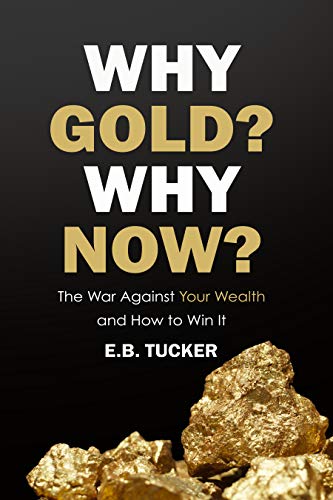
Author E.B. Tucker provides a powerful framework for understanding gold’s enduring value. His lessons are crucial for any gold investor, including a copy trader, as they ground you in the fundamental “why” behind your investment.
- Gold is Real Money: Unlike currencies, which can be printed infinitely, gold is finite and has been a store of value for millennia.
- The Royalty of Assets: It sits outside the conventional financial system, making it the ultimate hedge.
- Governments are the Biggest Buyers: The “official bid” from central banks provides a strong, consistent floor for the price.
- The “Everything Bubble”: When stocks, bonds, and real estate are all inflated, gold is the logical safe harbor.
- De-Dollarization is Real: The world is actively moving away from the US dollar as its sole reserve currency, a trend that directly benefits gold.
- Inflation is a Feature, Not a Bug: Governments have an incentive to devalue their currency; gold protects your purchasing power.
- Scarcity Creates Value: All the gold ever mined would fit into a small cube; this scarcity cannot be replicated.
- Don’t Confuse Price with Value: The daily “price” of gold fluctuates, but its intrinsic “value” as a monetary metal is constant.
- Geopolitical Chaos is Gold’s Friend: In a world of uncertainty, gold is the ultimate form of financial insurance.
- It’s About Wealth Preservation: The primary goal of owning gold isn’t to “get rich quick,” but to preserve the wealth you already have against systemic risks.
What is Leverage and How Does it Amplify Risk?
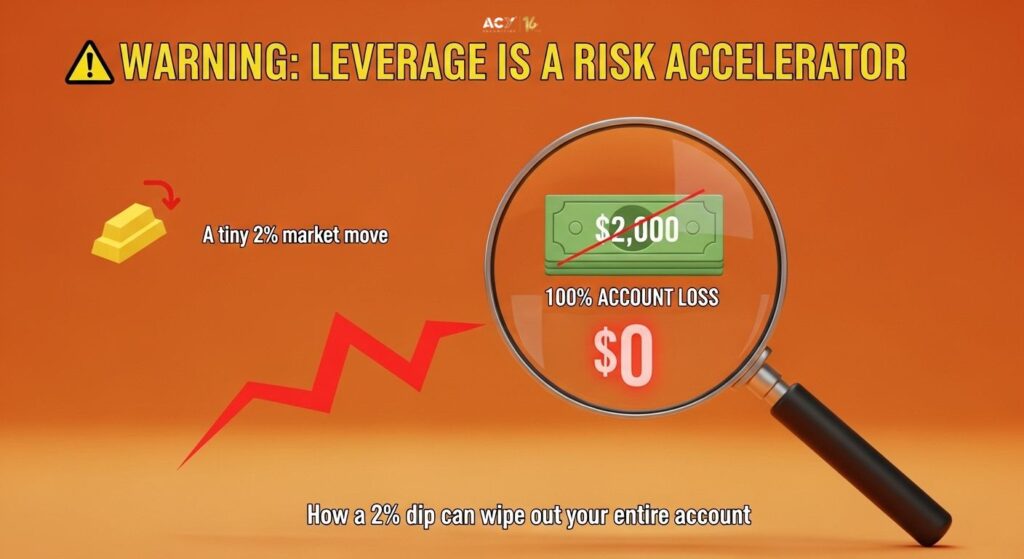
Leverage is a loan from your broker that allows you to control a large market position with a small amount of capital. A 100:1 leverage ratio means you can control a $100,000 gold position with just $1,000 of your own money (your “margin”). While marketed as a way to amplify profits, it is more accurately a risk accelerator.
Practical Impact on a $2,000 Account:
Imagine you open a $100,000 position in gold.
- A tiny 1% adverse price move results in a $1,000 loss. On your $2,000 account, that’s a 50% drawdown instantly.
- A 2% adverse move, a common occurrence for gold, results in a $2,000 loss. Your entire account is wiped out.
Leverage turns a recoverable market fluctuation into a catastrophic, account-ending event. For a beginner, choosing a low, conservative leverage ratio like 1:30 or lower is the single most important risk management decision you can make.
Can You Handle the Psychological Pressure?
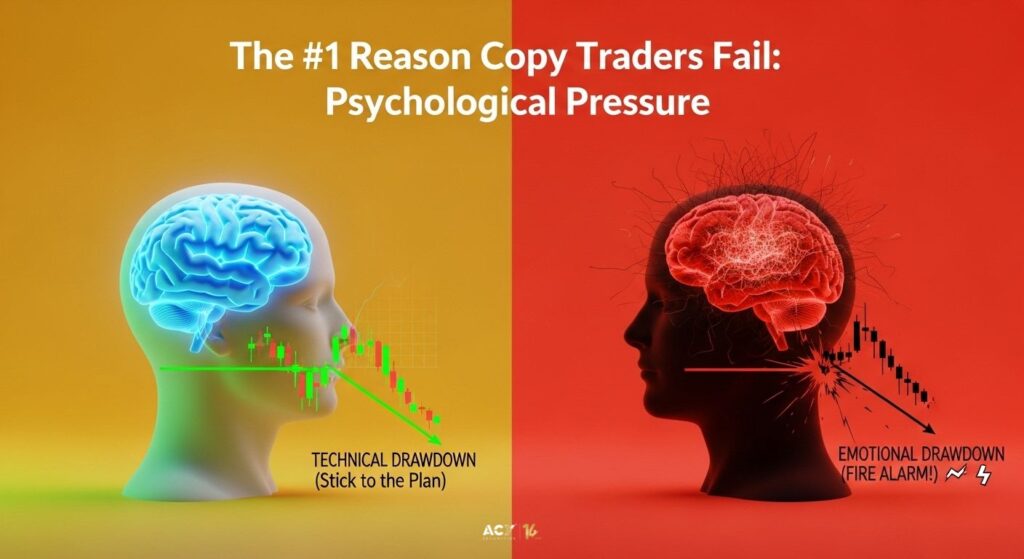
Copy trading presents a unique psychological challenge. You are exposed to the stress of market movements without having any control. The most difficult period will be a drawdown. You must learn to distinguish between two types:
- A Technical Drawdown: A normal string of losses that is statistically expected for the strategy. This should be endured with discipline.
- An Emotional Drawdown: The trader has lost control. They are revenge trading, abandoning their strategy, and taking irrational risks. This is a fire alarm, and you must stop copying immediately.
The “Copier’s Dilemma” is when you are at your most fearful, which is precisely when your lead trader is under the most pressure and most likely to make a mistake. The only defense is a pre-committed plan.
Your Action Plan: Building a Resilient $2,000 Portfolio
This is where theory becomes action.
1. Set Realistic Expectations: A trader’s advertised ROI is not your net return. After accounting for slippage (due to delays and spreads) and performance fees, you should mentally discount the advertised ROI by 20-40% to get a realistic forecast. A 40% advertised return might realistically translate to a $480-$640 annual profit on your $2,000 account.
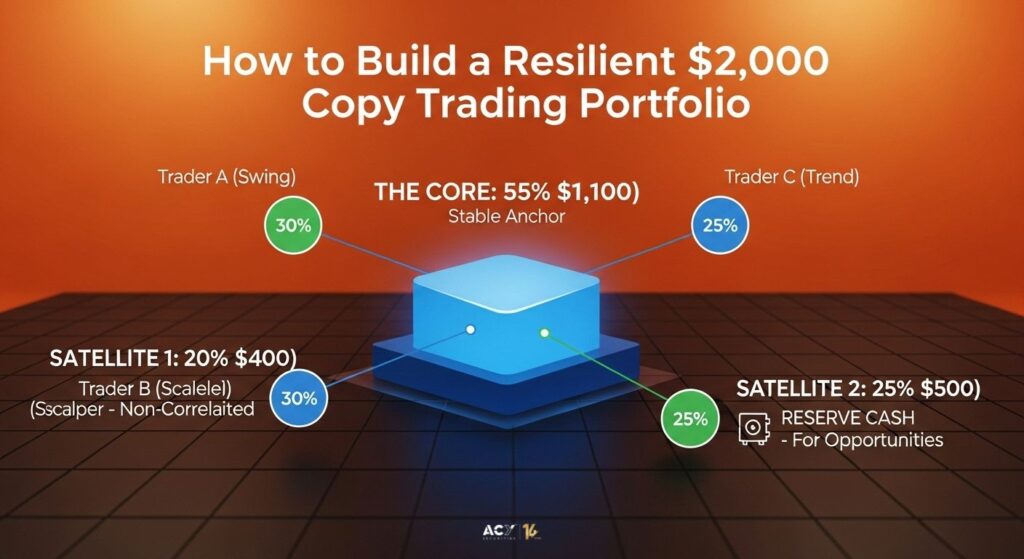
2. Build a Diversified Portfolio with the Core-Satellite Approach: The most effective way to manage risk is to diversify across different strategies. This creates an “all-weather” portfolio.
- The Core (50-60% of capital: $1,000 – $1,200): Allocate this to 1-2 low-risk, consistent traders like Trader A. They are your anchor, providing stability.
- The Satellites (40-50% of capital: $800 – $1,000): Allocate this to 2-3 traders with different, non-correlated strategies like Trader C (Trend-Follower) or even a highly-vetted Scalper. These are designed to boost returns and perform in different market conditions.
Sample $2,000 Portfolio Allocation:
| Component | Trader Profile | Strategy Archetype | Allocation | Rationale |
| Core 1 | Trader A (MDD 15%) | Swing Trader | $600 (30%) | Stable anchor, long-term trend capture. |
| Core 2 | Trader C (MDD 22%) | Trend-Follower | $500 (25%) | Consistent performance in directional markets. |
| Satellite 1 | Trader B (MDD 38%) | Scalper | $400 (20%) | Performs in range-bound markets, non-correlated. |
| Satellite 2 | Unallocated | Cash | $500 (25%) | Reserve capital to add to a winner or for a new opportunity. |
Your First 90 Days: A Monitoring and Adjustment Protocol
Your work isn’t done after you click copy. Active management is essential.
- Weekly Review (30 mins): Check your P/L. Compare your performance to the lead trader’s to gauge slippage. Read any updates from your traders.
- Monthly Review (1 hour): Conduct a full review of each trader’s stats. Has their MDD increased? Has their profit factor dropped? Are they still following their strategy?.
- Red Flag Protocol: Pre-commit to the conditions that will force you to act. For example: “If a trader’s drawdown exceeds their historical MDD by 5%, I will stop copying.”. This prevents emotional decision-making.
Final Checklist Before You Invest
Before you deploy a single dollar, ensure you can check every box on this list:
✅ Market Context Understood: You understand the current macroeconomic drivers and technical levels for XAUUSD.
✅ Due Diligence Complete: You have used a quantitative and qualitative framework to evaluate and score your chosen traders.
✅ Risk Tolerance Defined: You have selected traders whose Maximum Drawdowns are within your personal pain threshold.
✅ Leverage Set Conservatively: You have set your account’s leverage to a low, safe level (1:30 or less).
✅ Portfolio Constructed: You have built a diversified Core-Satellite portfolio of 3-5 traders with non-correlated strategies.
✅ Expectations Set Realistically: You understand the impact of slippage and fees on your potential net returns.
✅ Monitoring Plan in Place: You have a weekly and monthly review schedule and a defined Red Flag Protocol.
Success in copy trading requires a profound mental shift, from being a passive follower to becoming a disciplined portfolio manager. By combining a deep understanding of the market with rigorous due diligence and an unwavering focus on risk management, you can navigate the complexities of gold copy trading and build a sustainable and potentially profitable investment.
Frequently Asked Questions (FAQ)
Q1: What is a good Maximum Drawdown (MDD) for a copy trader?
A: The Maximum Drawdown (MDD) quantifies the worst historical loss of a strategy. General guidance suggests that a drawdown below 20% is tolerable for a robust strategy, while anything approaching or exceeding 30-40% indicates a high level of risk.
Q2: What is a Profit Factor and why is it important?
A: The Profit Factor is a powerful metric calculated by dividing the total gross profit by the total gross loss. A value greater than 1.0 indicates profitability. A high Profit Factor (e.g., above 1.8) is a strong sign of a healthy trading strategy, as it shows that winning trades are significantly out-gaining losing trades.
Q3: How does slippage affect my copy trading returns?
A: Slippage is the performance gap between the lead trader and the copier, and it acts as a hidden cost. It’s caused by execution delays, price moves during those delays, and differences in broker spreads. This means your net return will almost always be lower than the lead trader’s advertised return.
Q4: What is the difference between a Scalper and a Swing Trader?
A: A Scalper trades with very high frequency, holding positions for just seconds or minutes to capture many small profits. A Swing Trader operates on a much longer timescale, holding positions for days or even weeks to capture a larger “swing” in the market’s trend.
Q5: What is the most important risk to consider in copy trading?
A: While market risk is obvious, the most significant and unique risk in copy trading is
Strategy Provider Risk, the human risk. Your entire investment depends on the skill, discipline, and psychological stability of a single individual you are copying. A mistake, a strategy change, or an emotional breakdown on their part directly impacts your capital.
(Disclaimer: This article is for informational and educational purposes only. It should not be considered financial advice. Always conduct your own research and consult with a qualified financial advisor before making any investment decisions.
For more detailed insights on developing daily trading routines, risk management, and effective position sizing strategies, explore additional articles on Trading Cup. Our trading experts at ACY and FinLogix are also great resources to guide your journey towards trading excellence.

Discover Our Best Trading Signals
At Tradingcup, you can browse through a selection of signals and review past performance before you decide to copy.
Become A Signal Provider
Share your expertise and become a signal provider so other traders can copy your trades.
Stay tuned to our blog for more trader spotlights and leaderboard updates.
Trading involves risks.
Visit the Tradingcup blog through the link below for more updates: https://www.tradingcup.com/learn
Related Copy Trading blogs:
- Understanding Market Liquidations: Liquidity Sweeps and Runs Explained
- 7 Essential Daily Habits of Successful Traders to Outperform Their Peers
- 10 Strategies You Can Copy off Our Best Copy Traders
- 5 Strategies Every Trader Can Master To Trade Better In A Trading Contest
- 2025 Copy Trading Scams Exposed: How to Spot Fraud
- A Swing Trading Strategy with an 83 Percent Win Rate and Low Drawdowns
- Forex Martingale Strategies Explained, The Good, The Bad and The Ugly
- Pyramiding Trading Tutorial – Pros & Cons & How to Use It