
Why Copying One Forex Trader Is an Investment You Can’t Afford to Make: The Ultimate Guide to Smarter Copy Trading

TradingCup
JUN 23 2025
Last Updated: June 23, 2025
This article is reviewed annually to reflect the latest market regulations and trends.
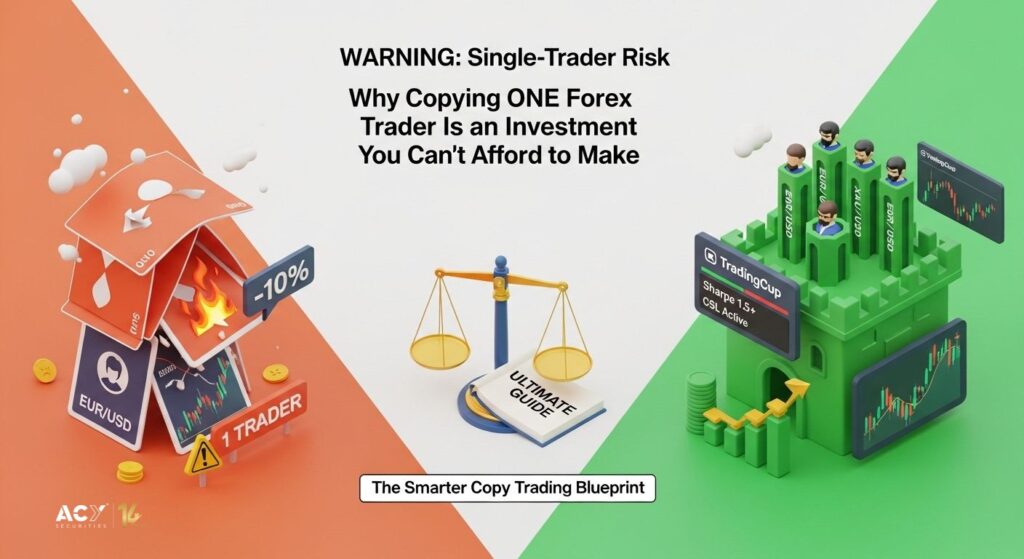
Disclaimer: The information in this article is for educational purposes only and does not constitute financial, investment, or trading advice. Copy trading carries substantial risks, including the potential loss of your entire invested capital. Past performance of copied traders or strategies is not a reliable indicator of future results. You may be replicating high-risk trades, overleveraged positions, or strategies incompatible with your financial goals. Always conduct independent research into a trader’s historical performance, risk metrics, and strategy before copying them. Never invest funds you cannot afford to lose. Consult a licensed financial advisor to ensure copy trading aligns with your risk tolerance, financial objectives, and regulatory requirements in your jurisdiction. This article does not endorse specific traders, platforms, or strategies, and all trading decisions remain your sole responsibility.
TL;DR:
Don’t let a single trader make your portfolio fade, With these five points, a smarter choice is made.
- A single forex trader brings concentrated risk, a dangerous game to play.
- Your own psychology can lead your focus astray.
- With a diverse team, your portfolio can climb; copying many is better than one at a time.
- Use proper tools and a risk-based strategy; it’s the key to your financial prosperity.
- To truly succeed and make your portfolio thrive, you must learn to properly diversify.
“The biggest mistake investors make is to believe that what happened in the recent past is likely to persist. They assume that something that was a good investment in the recent past is still a good investment. Typically, high past returns simply imply that an asset has become more expensive and is a poorer, not a better, investment.”
– Ray Dalio
Is Copy Trading Good For Beginners?
Many professionals, juggling demanding careers, family life, and personal commitments, are drawn to the immense potential of the foreign exchange (Forex) market. They hear stories of financial freedom and see the allure of a market that operates 24 hours a day, but they are also acutely aware that mastering its complexities, understanding macroeconomic indicators, technical analysis, and risk management can take years of dedicated study and practice. This is a luxury most do not have.
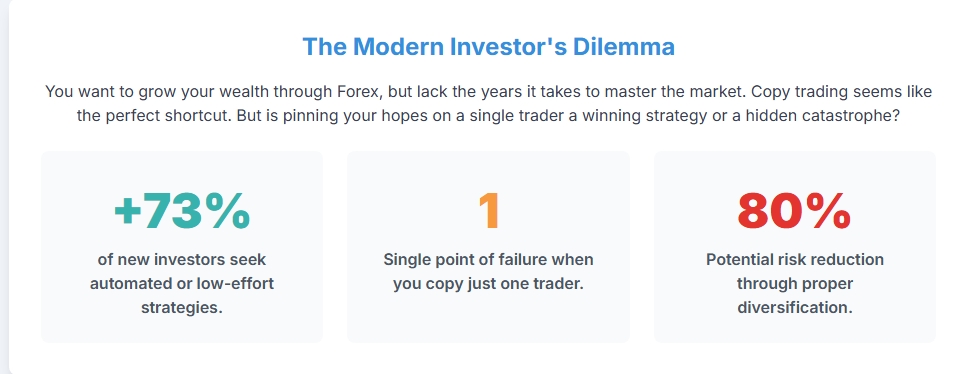
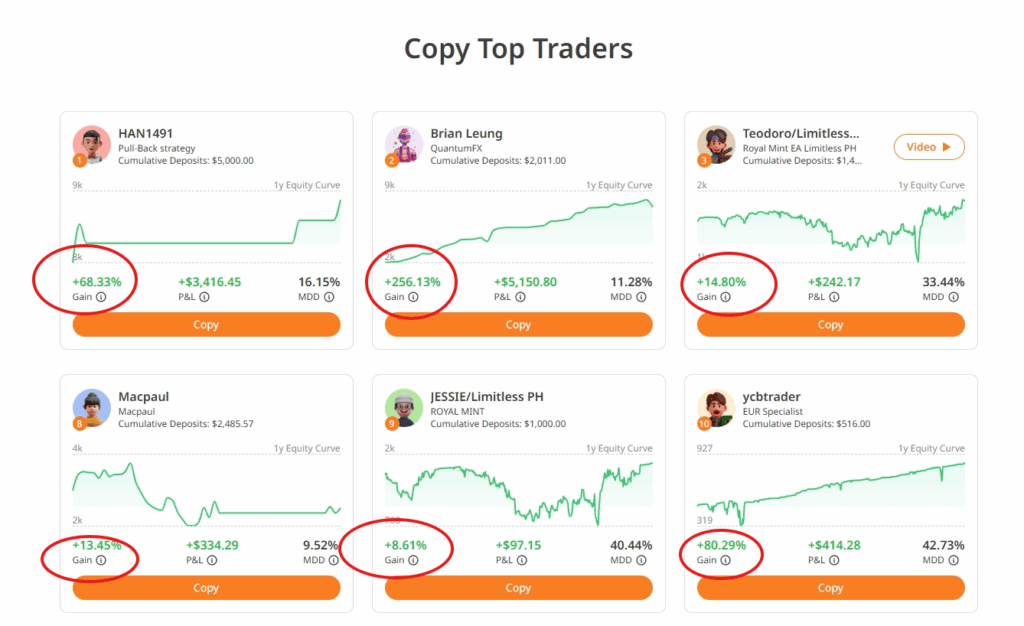
Into this dilemma steps a seemingly perfect solution: copy trading. It presents itself as a “plug-and-play” answer, a way to bypass the steep learning curve and leverage the expertise of seasoned professionals. The discovery process is often intoxicating. An investor finds a platform, scrolls through a leaderboard gleaming with high-performance metrics, and spots a trader with a stunning 300% annual return. The question that immediately forms is powerful and seductive:
Why not just allocate capital to this proven winner and enjoy the ride? Is it truly that simple, or is there a critical catch the leaderboards are not showing? This report will demonstrate that behind the promise of simplicity lies a complex web of risks, and that true success requires a far more sophisticated approach than merely picking one star player.
What Exactly is Forex Copy Trading? Hasn’t This Been Around Forever?
At its core, Forex copy trading is a branch of social trading that enables an investor to automatically replicate the trades of another, often more experienced, trader. The mechanics involve an investor (the “copier”) linking a portion of their capital to the account of a selected trader (the “Master Trader” or “Signal Provider“). From that point on, every action taken by the Master Trader, opening a position, setting a stop-loss, or closing a trade, is executed in the copier’s account in real-time, typically in proportion to the allocated funds.
While the technology feels modern, the concept has a clear lineage. It evolved from earlier forms of signal sharing, which began with traders distributing their trade intentions via newsletters. This progressed to virtual chat rooms where a lead trader would announce their actions for followers to manually replicate. The fundamental shift with modern copy trading platforms is automation. The one-click process removes the friction and the moment of deliberate, manual decision-making that existed in older models.
This evolution from manual signal-following to automated replication has profoundly altered the psychological dynamic for the investor. The absence of a “pause for thought” before executing a trade makes it significantly easier for emotional biases and impulsive decisions to take hold without a crucial check-and-balance. This technological convenience, while appealing, inadvertently amplifies many of the psychological risks that can lead to financial loss, a theme that is central to understanding how to navigate copy trading successfully.
Why Does Relying on One Trader Feel So Risky?
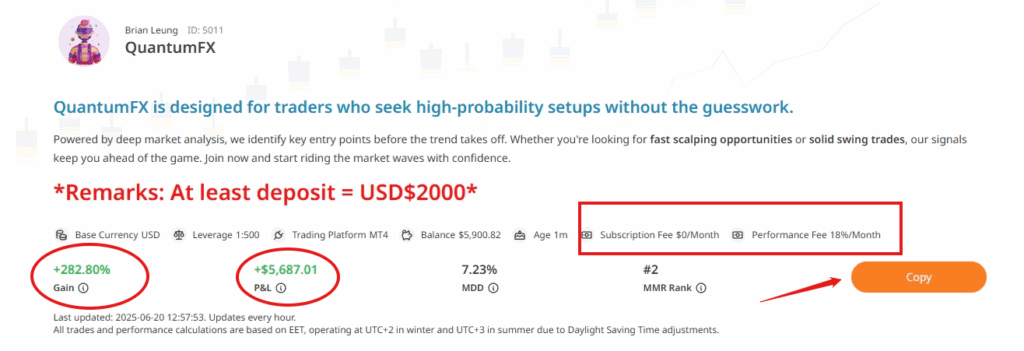
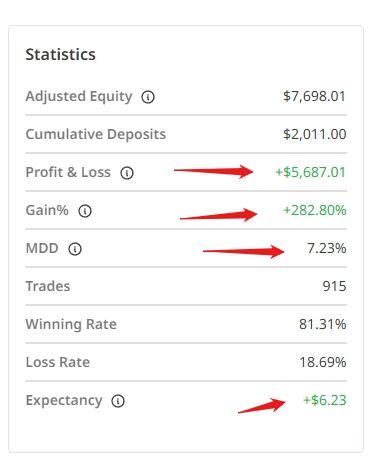
The decision to entrust one’s capital to a single trader is fundamentally a decision to accept a concentrated, single point of failure. While it may seem like a straightforward path to mirroring success, it exposes an investor’s portfolio to a host of vulnerabilities that are often hidden behind impressive, short-term performance statistics.
The All-Your-Eggs-in-One-Basket Catastrophe: A Universe of Scenarios
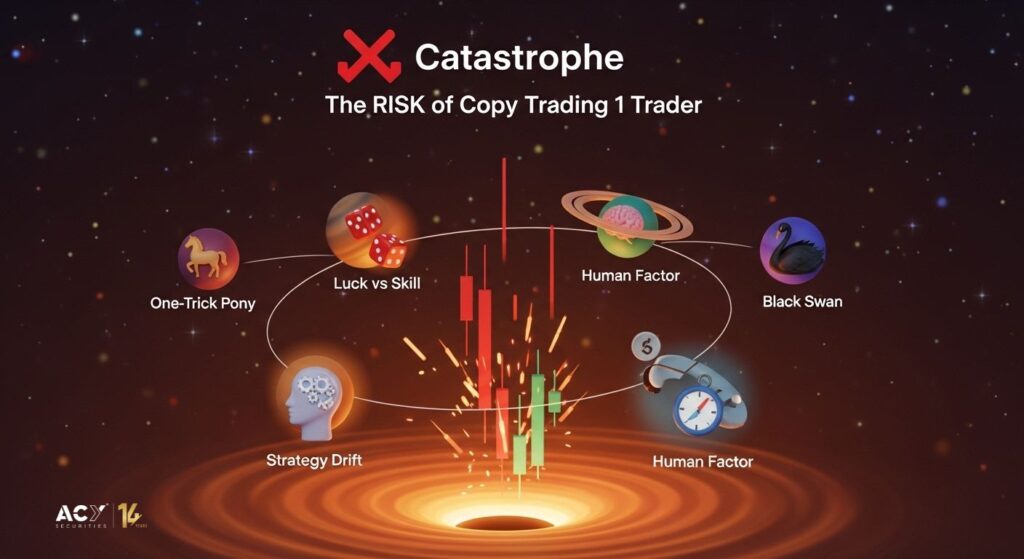
Relying on a single trader is not just risky; it introduces a multitude of distinct failure scenarios, each capable of causing significant financial damage. Understanding these potential pitfalls is the first step toward building a more resilient strategy.
- The “One-Trick Pony” Risk: A trader may have a strategy that performs exceptionally well in a specific market environment, such as a strong trending market. However, when market conditions shift to a sideways, range-bound pattern, that same strategy can quickly unravel and generate substantial losses. The copier, who was attracted by the trader’s success in one regime, is now unknowingly exposed to their failure in another.
- The “Luck vs. Skill” Deception: In any field with a degree of randomness, short-term success can be difficult to distinguish from genuine skill. Many leaderboards are dominated by traders who are not necessarily brilliant strategists but are simply on a lucky streak. As research suggests, a significant portion of successful records in copy trading may be attributable to randomness rather than consistent expertise. For the copier, this means they may be betting on a statistical anomaly that is due for a reversion to the mean, often with painful consequences.
- The “Human Factor” Risk: Even expert traders are human. They can make calculation errors, succumb to emotional pressures like the Fear of Missing Out (FOMO), or experience personal issues that affect their judgment. A Reddit user aptly described this risk: “Forex copytrading is letting a lone individual decide your fate. 1 day the dude wakes up and decides to quit and blows all your accounts up”. When copying one person, the investor is not just mirroring their strategy but also their psychological state, with no control or insight.
- The “Strategy Drift” Risk: A trader might, without any announcement, alter their trading style. They could shift from a low-risk approach to a high-leverage, high-risk strategy, or change the assets they trade from stable major currency pairs to volatile exotics. The copier, who signed up for one risk profile, is now exposed to a completely different and potentially much larger set of risks.
- The “Black Swan” Event: Markets are subject to unpredictable, high-impact events, from sudden geopolitical crises to unexpected central bank announcements. A strategy concentrated in a single trader, who may in turn be concentrated in a single asset or currency pair, is acutely vulnerable to such “black swan” events. A diversified portfolio is designed to weather these storms, while a single-thread portfolio can be wiped out by one.
The overarching danger is not merely that the chosen trader might lose money. It is the complete lack of control and the profound information asymmetry. The copier is outsourcing the entire risk management process, creating a critical blind spot where they are inheriting a black box of unknown psychological states, potential strategic shifts, and human error.
The Hidden Friction: Market Chaos and Platform Pitfalls

Beyond the risks directly associated with the trader, there are external factors and platform-specific issues that can erode a copier’s returns. These “hidden frictions” are often overlooked by beginners.
- Liquidity Risk: This is the risk that an investor may not be able to exit a position at the desired price due to a lack of buyers or sellers in the market. This is particularly pronounced in less-traded, “exotic” currency pairs or during times of high market volatility. The Master Trader might get their order filled, but the wave of copycat trades that follow can struggle to find liquidity, leading to significant losses.
- Slippage: Closely related to liquidity, slippage is the difference between the price at which the Master Trader executed their trade and the price at which the copier’s replicated trade is executed. Even a negligible delay between the two trades can result in a worse entry or exit price for the copier, especially in fast-moving markets. Over many trades, slippage can significantly eat into profits.
- Platform Risks and Hidden Costs: The platform itself can introduce risk. Technical issues like network outages can prevent trades from being executed at critical moments. More subtly, the platform’s business model may not be perfectly aligned with the copier’s interests. As some Reddit users have pointed out, on certain platforms, the most popular traders may pay no trading fees, while their copiers pay a commission on every single trade. The Master Trader might also earn commissions from the platform based on the volume of trades copied. This creates an incentive for the Master Trader and the platform to encourage high-frequency trading activity, from which they both profit, regardless of whether that activity is profitable for the copier. This misalignment can encourage risk-taking that benefits others at the copier’s expense.
Is Copy Trading Forex Safer Than Crypto?
A common question for newcomers is whether to apply copy trading to the established Forex market or the volatile world of cryptocurrency. The answer is not about which is universally “safer,” but about understanding the different types of risk each market presents. A direct comparison reveals a stark contrast in their risk profiles.
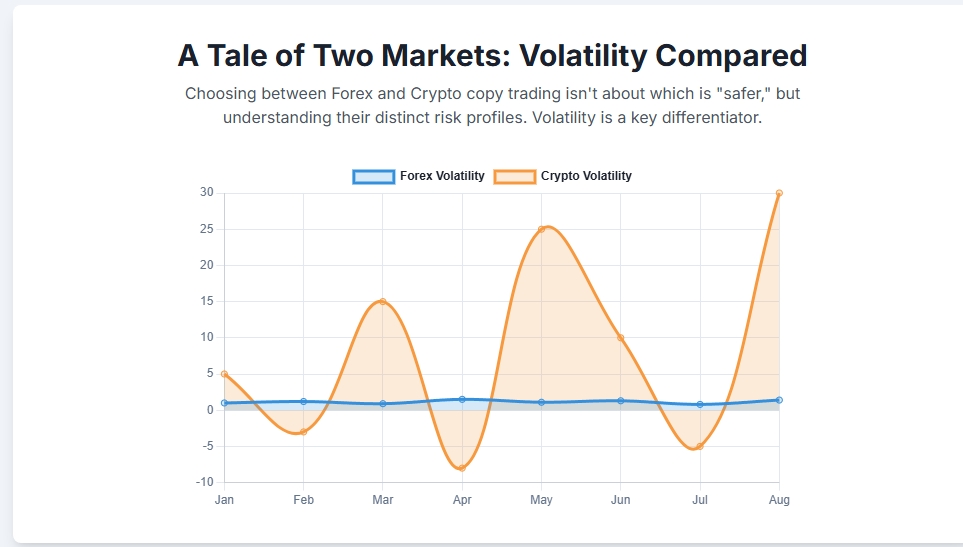
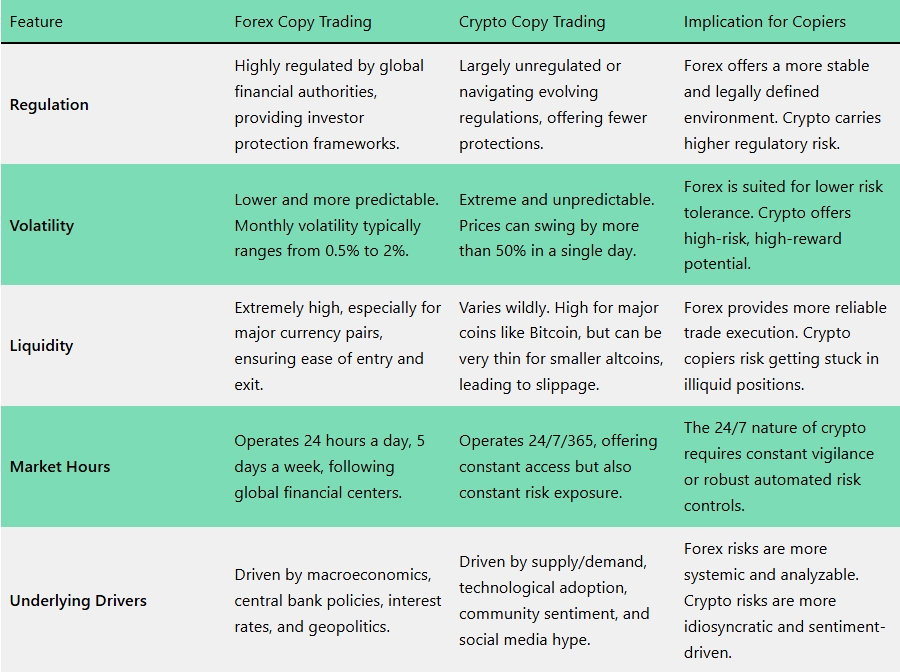
Ultimately, the choice is not about finding a risk-free haven but about selecting the risk profile that aligns with an investor’s goals and temperament. Forex risk is often tied to the predictable (or at least analyzable) world of global economics. Crypto risk is more tied to the unpredictable nature of technological disruption and viral sentiment. A truly sophisticated investor understands these differences and may even seek exposure to both types of risk within a diversified portfolio, rather than betting exclusively on one.
The Psychology of the Crowd: Are Your Own Biases Setting You Up for Failure?
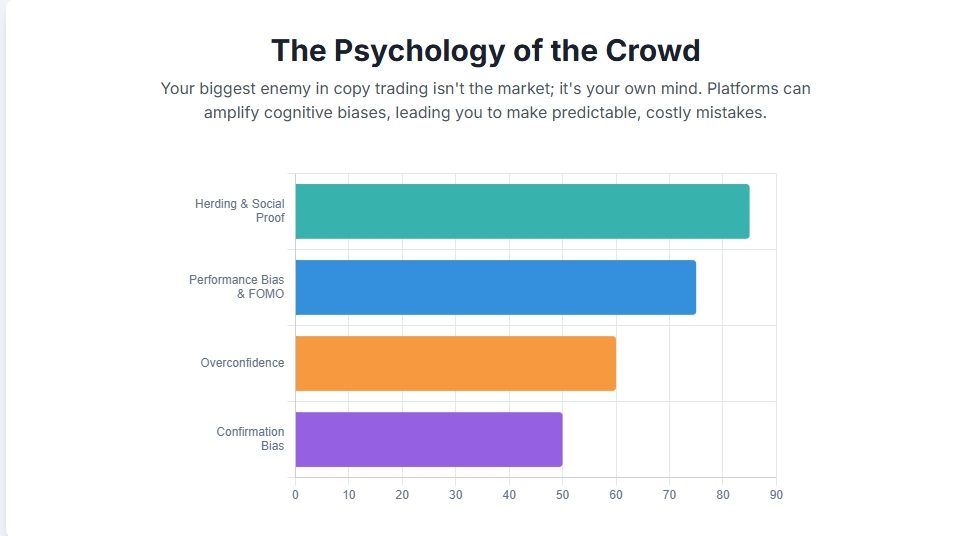
While external market risks and trader-specific failures are significant, extensive research shows that the greatest threat to a copy trader’s capital often comes from within. The psychological biases that govern human decision-making are particularly potent in the high-stakes environment of financial markets, and copy trading platforms can inadvertently become arenas where these biases lead investors astray.
The Leaderboard: Deconstructing Your Decision-Making
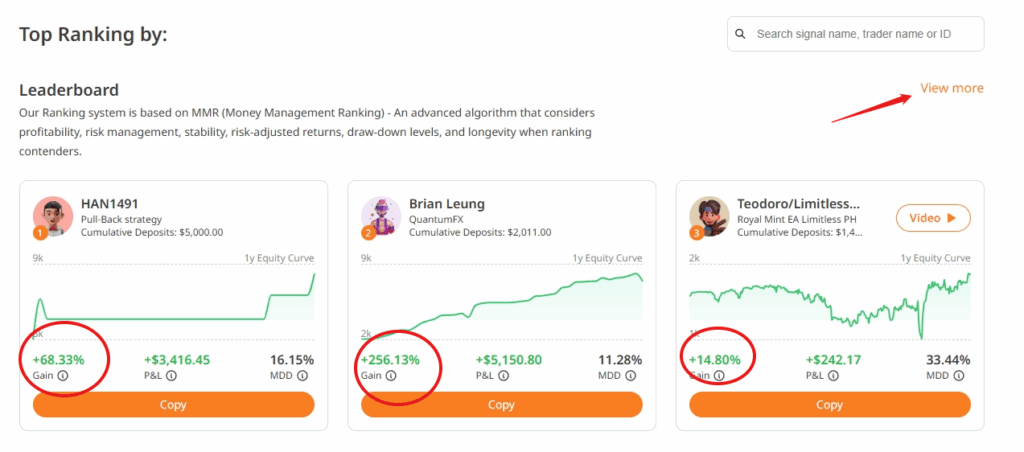
The typical process of selecting a trader to copy is fraught with psychological traps. The design of many platforms, with their prominent leaderboards and social features, can amplify cognitive biases rather than encourage rational analysis.
- Social Proof & Herding: When an investor sees that a trader is being copied by thousands of others, the powerful bias of social proof kicks in. The mental shortcut is, “If so many other people think this trader is good, they must be right”. This leads to a herding effect, where popularity becomes a self-fulfilling prophecy, attracting more followers irrespective of the underlying strategy’s quality or risk level.
- Performance Bias & FOMO: Humans are wired to extrapolate recent performance into the future. Leaderboards that prominently display high short-term returns trigger performance bias, leading investors to focus exclusively on recent gains while ignoring long-term consistency or risk metrics. This is compounded by the Fear of Missing Out (FOMO), a powerful emotional driver that compels investors to jump on a popular trend for fear of being left behind.
- Overconfidence: After picking a “winner,” an investor can fall into a state of overconfidence, blindly trusting the copied trader’s every move. This leads to the dangerous neglect of personal risk management, as the copier assumes the expert has everything under control.
- Confirmation Bias: Once a decision is made, confirmation bias causes the investor to actively seek out information that validates their choice while dismissing or ignoring red flags. They might focus on a trader’s winning streak while explaining away a large drawdown as a “one-time event.”
It is crucial to understand that these are not just accidental user behaviors; they are often responses to an environment engineered to maximize engagement. Leaderboards, popularity rankings, and gamified elements are features designed to trigger these psychological responses, which in turn can lead to higher trading volumes for the platform. Awareness that the platform’s interface is not a neutral field of data but a persuasive environment is the first step toward developing immunity to its more manipulative aspects.
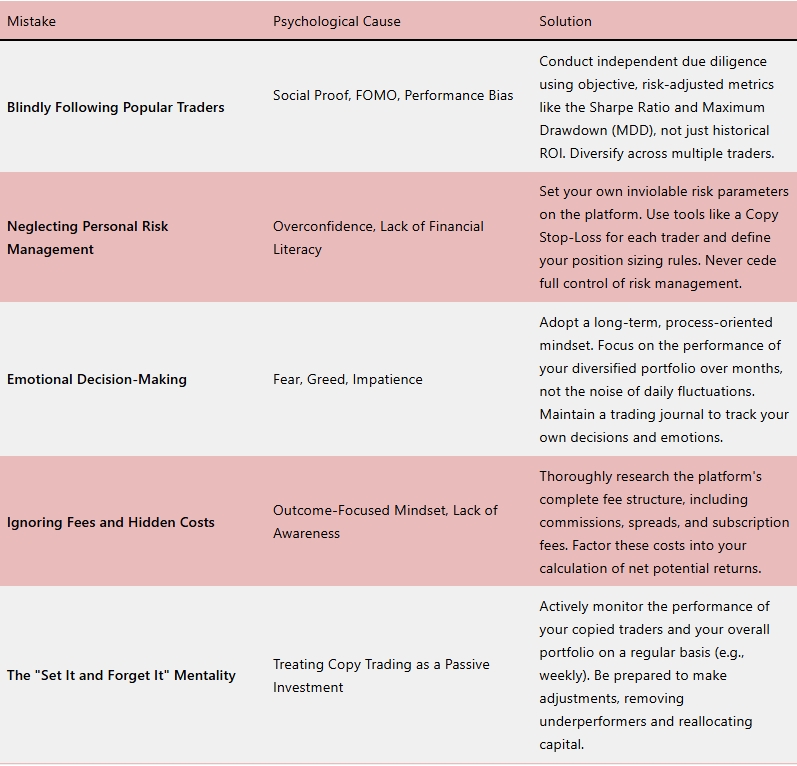
The Beginner’s Usual Mistakes (And How to Flip the Script)
The culmination of these psychological biases leads to a predictable set of mistakes made by novice copy traders. By identifying these errors, one can create a clear playbook for avoiding them.
The Billionaire’s Blueprint: How Would Ray Dalio Approach Copy Trading?
The problem of relying on a single source of returns is not unique to retail copy trading. It is a fundamental challenge in institutional investing, and one that has been effectively solved by some of the world’s most successful investors. By applying the principles of hedge fund titan Ray Dalio, founder of Bridgewater Associates, a copy trader can elevate their approach from simple gambling to sophisticated portfolio management.
The “Holy Grail” of Investing – Slashing Risk Without Sacrificing Returns
Ray Dalio’s core investment philosophy revolves around what he calls the “Holy Grail of Investing.” He argues that the key to long-term success is not to find the single best investment, but to combine 10 to 15 good, uncorrelated return streams. A “return stream” is simply an asset or strategy that is expected to make money. The magic lies in the word “uncorrelated,” which means the assets do not all move in the same direction at the same time.
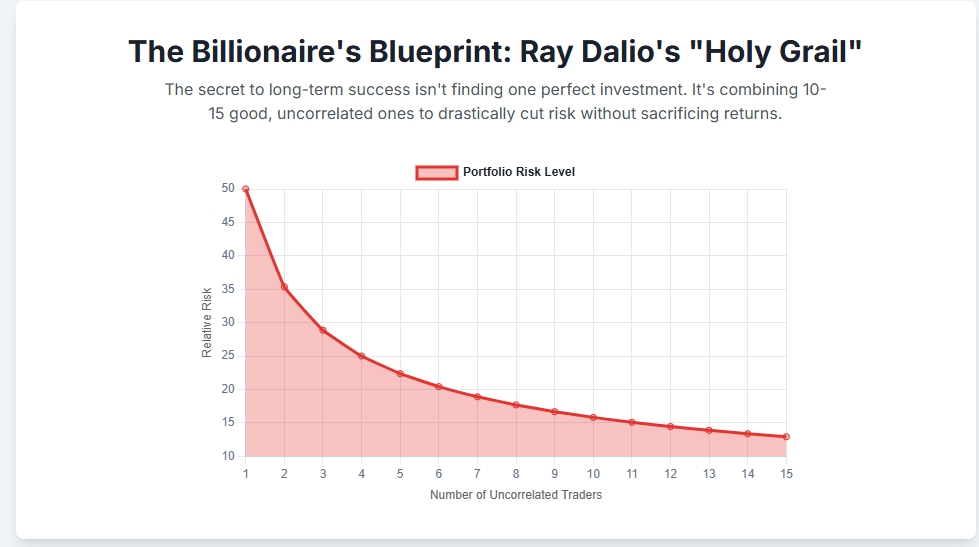
By combining a portfolio of these uncorrelated assets, Dalio demonstrated that an investor can dramatically reduce their overall risk by as much as 80%, while still achieving the same average return as any single one of the components. This improves the return-to-risk ratio by a factor of five, an advantage that is nearly impossible to achieve by trying to be better at picking individual winners.
This philosophy is the perfect antidote to the beginner’s quest to find the one “magic” trader who will never lose. Dalio’s approach is built on the humble acceptance that the future is unknowable. As he famously said, “He who lives by the crystal ball will eat shattered glass”. Instead of trying to predict the future, his “All-Weather” strategy is designed to build a robust portfolio that can perform reasonably well in any economic environment, whether growth is rising or falling, and whether inflation is rising or falling. The goal is resilience and survival, which are the true foundations of long-term wealth generation.
Building Your “All-Weather” Copy Trading Portfolio
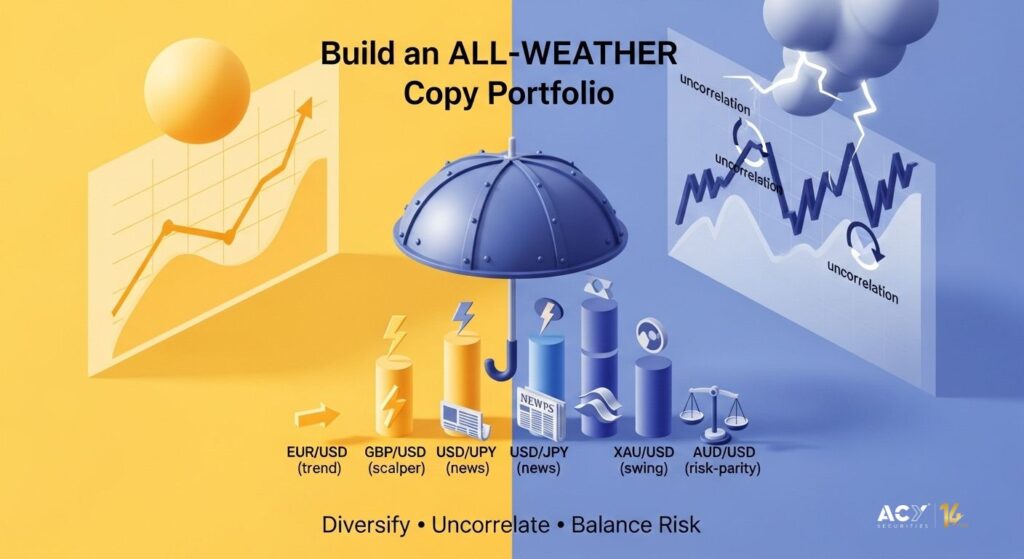
Translating Dalio’s institutional framework to retail copy trading provides a clear, actionable blueprint for moving beyond the risk of a single trader. The principles are directly applicable.
- Principle 1: Diversify Your “Return Streams” (The Traders). The most obvious application is to stop copying one trader and instead build a portfolio of several, perhaps 5 to 10, Master Traders. This immediately diversifies the human-factor risk and the single-strategy risk.
- Principle 2: Seek Uncorrelated Traders. This is the most crucial step. Diversification is not achieved by simply picking five traders who are all successful. If all five employ a trend-following strategy on the EUR/USD pair, they are highly correlated; they will likely win together and lose together. True diversification requires seeking out traders with different, uncorrelated profiles:
- Different Strategies: Combine a trend-follower with a range-bound scalper, a news-based trader, and a long-term swing trader.
- Different Asset Classes: Ensure the portfolio includes traders who specialize in different instruments. For example, one might focus on major Forex pairs (EUR/USD, GBP/USD), another on commodity currencies (AUD/USD), and another still on precious metals like Gold (XAU/USD).
- Different Timeframes: Mix traders who operate on short-term charts (e.g., 15-minute) with those who hold positions for days or weeks. The goal is to construct a portfolio where a loss in one component is potentially offset by a gain in another, smoothing the overall equity curve.
- Different Strategies: Combine a trend-follower with a range-bound scalper, a news-based trader, and a long-term swing trader.
- Principle 3: Risk Parity is Key. A more advanced application of Dalio’s thinking is the concept of risk parity. This means allocating capital not equally among traders, but based on their contribution to the portfolio’s overall risk. In simple terms, a trader with a history of high volatility and large drawdowns would receive a smaller capital allocation than a trader with a record of steady, low-volatility returns. This ensures that no single high-risk trader can dominate and sink the entire portfolio.
The Master Trading Coach’s Wisdom: 10 Lessons from Van Tharp to Revolutionize Your Approach
If Ray Dalio provides the “what,” the blueprint for a diversified portfolio structure, then renowned trading psychologist and coach Dr. Van K. Tharp provides the “how”, the internal, psychological framework required to manage that portfolio effectively. Tharp’s work focuses on the traders themselves as the most critical component of any trading system.
“You Don’t Trade the Market, You Trade Your Beliefs”
Dr. Tharp’s fundamental thesis, articulated over decades of coaching top traders, is that an individual’s trading results are a direct and unavoidable reflection of their personal psychology, mental states, and, most importantly, their beliefs about the market. He argued that searching for a “holy grail” external system is a futile exercise. Success is an internal game won through self-awareness, discipline, and the development of a system that aligns with one’s own unique psychological profile. For a copy trader, this means the selection and management of their portfolio of traders is a mirror of their own beliefs and biases.
10 Actionable Lessons from “Trade Your Way to Financial Freedom”
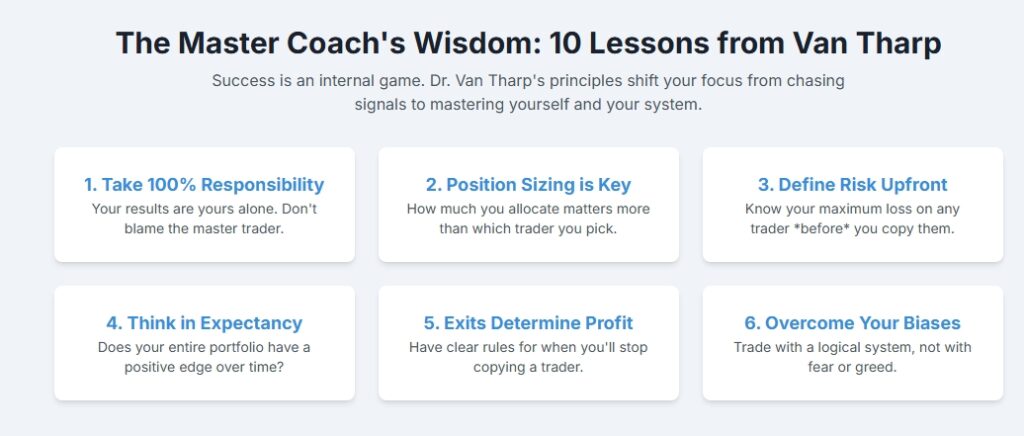
Tharp’s seminal book, Trade Your Way to Financial Freedom, offers a masterclass in the principles of successful trading. Applying its lessons can transform a novice copy trader from a passive follower into a disciplined risk manager.
- Psychology is 100% of the Game: Every decision in copy trading, which traders to pick, when to add funds, when to panic and stop copying, is governed by your mindset. Tharp believed everything about trading is psychological.
- Take Personal Responsibility: It is easy to blame a losing streak on the Master Trader or “market manipulation.” Tharp insists that traders must take 100% responsibility for their results. The performance of a copy trading portfolio is the responsibility of the person who designed, funded, and managed it.
- Develop a System That Fits YOU: Do not blindly copy a portfolio that worked for someone else. Your chosen group of traders, your allocation rules, and your risk parameters must align with your personal financial goals and, critically, your tolerance for risk and drawdowns.
- Entry is the Least Important Part: Novice traders obsess over finding traders with perfect entry signals. Tharp argues this is the least important part of a trading system. A copy trader should spend far less time looking for “perfect” entries and far more time defining their risk and portfolio management rules.
- Define Your Risk Upfront (The “R” Multiple): Before entering any trade, a professional trader knows their initial risk (1R), the maximum amount they are willing to lose on that position. For a copy trader, this means defining the risk on each copied trader. For example, setting a Copy Stop-Loss at $200 means 1R for that relationship is $200. This becomes the fundamental unit for measuring risk and reward.
- Think in Terms of Expectancy: A system’s expectancy is the average amount it makes per dollar risked over many trades. A copy trader must ask: Does my entire portfolio of copied traders have a positive expectancy? If the average trade across all copied traders yields a gain of 1.5R, the portfolio has a positive expectancy and is likely to be profitable long-term.
- Position Sizing is the Key to Meeting Your Objectives: Tharp’s most crucial lesson is that how much capital is allocated to each trade (or in this case, each Master Trader) is far more important for achieving one’s goals than the system itself. A brilliant portfolio of traders can be ruined by poor allocation (risking too much), while a mediocre portfolio can be profitable with excellent position sizing.
- Exits Determine Profitability: Your entry (choosing a trader to copy) is one decision. Your exits are just as, if not more, important. This includes having predefined rules for when to stop copying a trader, for instance, if they exceed their historical maximum drawdown or if their strategy’s expectancy turns negative.
- Overcome Your Biases: A successful trader must actively work to recognize and counteract the psychological biases discussed earlier. This requires self-awareness and a commitment to making decisions based on a predefined, logical system rather than on fear or greed.
- Plan for the Worst-Case Scenario: Before starting, mentally rehearse what you will do during a significant drawdown. How will you feel if your portfolio is down 20%? What is your plan of action? Having a plan in place prevents panic and emotional decision-making when adversity inevitably strikes.
The philosophies of Dalio and Tharp are not contradictory; they are two essential sides of the same coin. Dalio provides the framework for building a resilient external structure (the diversified portfolio). Tharp provides the framework for building a resilient internal structure (the disciplined trader). A diversified portfolio can still be destroyed by panic and poor position sizing. A psychologically strong trader is still exposed to catastrophic failure if they make a single, concentrated bet. The ultimate goal is to become both a portfolio architect in the style of Dalio and a disciplined risk manager in the style of Tharp.
Why TradingCup is the Ideal Platform for the Smart Trader
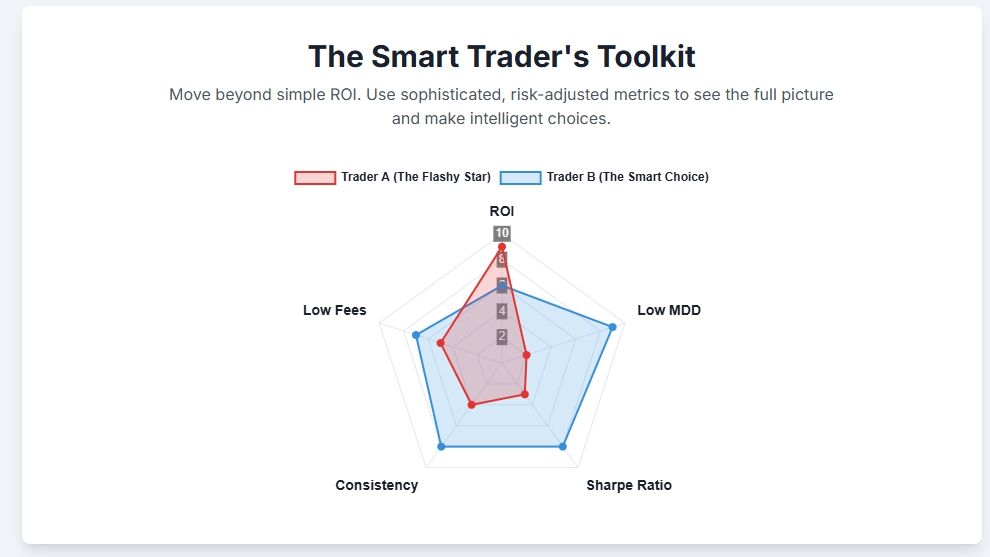
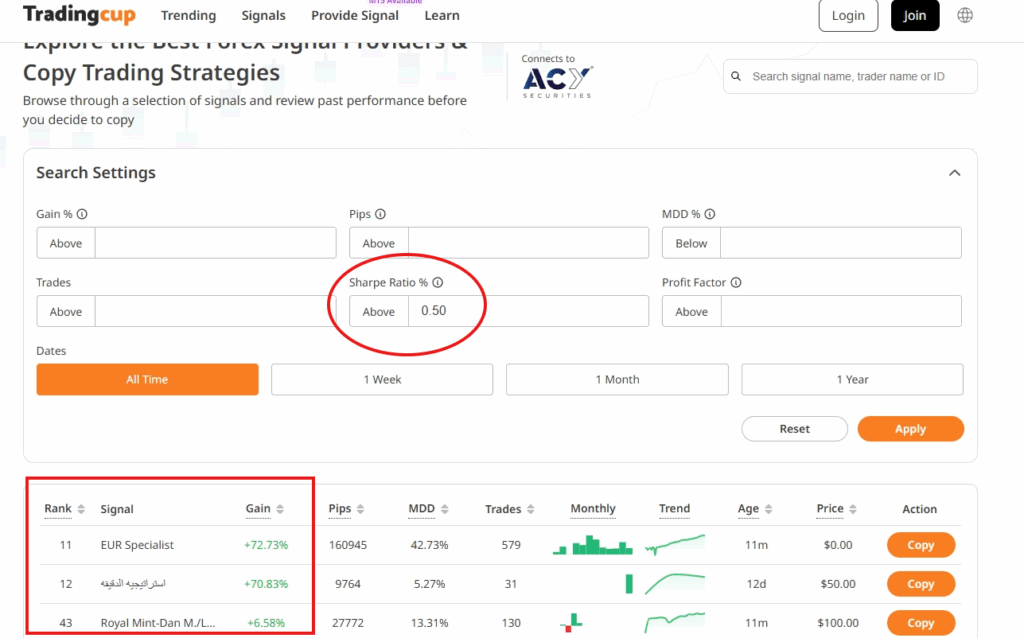
While many platforms exist, TradingCup is positioned as a premier choice for the intelligent, risk-aware investor who wishes to implement the advanced strategies outlined in this report. It provides the necessary infrastructure to move beyond simplistic, high-risk copying and engage in sophisticated portfolio management. The platform is designed around:
- Transparent Analytics: TradingCup offers users a clear and comprehensive view of a trader’s performance, emphasizing crucial risk-adjusted metrics like the Sharpe Ratio and Maximum Drawdown. This transparency empowers users to make informed decisions based on a complete picture of risk and reward.
- Advanced Risk Management: The platform provides robust and user-friendly risk management tools, including a granular Copy Stop-Loss feature and flexible custom allocation options. This allows copiers to enforce their own risk rules, as advocated by Van Tharp.
- A Diverse Marketplace of Traders: To build a truly “All-Weather” portfolio, an investor needs choice. TradingCup hosts a wide and diverse marketplace of Master Traders, covering a multitude of strategies, timeframes, and asset classes, including Forex majors, minors, exotics, and commodities like Gold (XAU/USD). This variety is essential for finding the uncorrelated return streams that form the bedrock of a resilient portfolio.
Your Step-by-Step Guide to Smarter Copy Trading on TradingCup
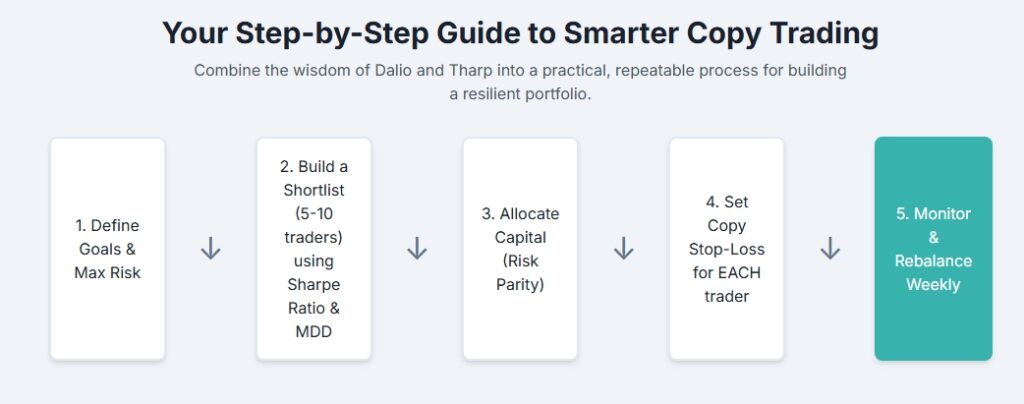
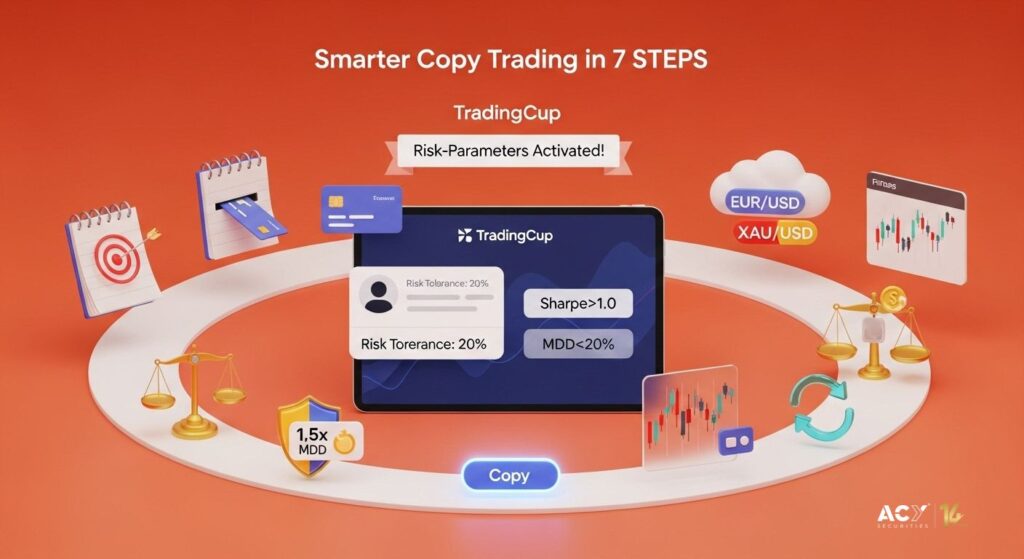
This section synthesizes the philosophies of Dalio and Tharp and the tools discussed into a single, actionable workflow for getting started on the TradingCup platform.
- Step 1: Define Your Goals & Risk Tolerance (The Tharp Foundation). Before logging in, take out a piece of paper and answer these questions: What is my realistic target for annual returns? What is the absolute maximum percentage of my capital I am willing to lose in a worst-case scenario (my maximum tolerable drawdown)? Your answers will be your personal constitution for every decision that follows.
- Step 2: Open and Fund Your TradingCup Account. Complete the straightforward registration and funding process on the TradingCup platform.
- Step 3: Build Your “All-Weather” Shortlist (The Dalio Method). Navigate to the trader discovery section. Use TradingCup’s advanced filters to build a shortlist of 5-10 potential traders. Do not sort by ROI. Instead, filter for:
- Traders with a Sharpe Ratio greater than 1.0.
- Traders with a Maximum Drawdown below your personal tolerance (e.g., <20%).
- A mix of strategies (e.g., search for keywords like “scalper,” “swing,” “trend”).
- A mix of primary assets (e.g., ensure some focus on EUR/USD, others on cross-pairs, and at least one who specializes in Gold (XAU/USD) to add a commodity dimension).
- Traders with a Sharpe Ratio greater than 1.0.
- Step 4: Allocate Capital with Risk Parity in Mind. Once you have your shortlist, decide how to allocate your copy trading capital. Do not allocate it equally. As a simple rule of thumb for risk parity, give a smaller percentage of your capital to the traders with higher volatility and higher MDD, and a larger percentage to the steadier, lower-MDD traders.
- Step 5: Set Your Personal Safety Nets. For each individual trader you decide to copy, go into the TradingCup copy settings and set a Copy Stop-Loss. A prudent rule is to set the CSL at a level slightly higher than their historical Maximum Drawdown (e.g., 1.5x MDD). This is your non-negotiable emergency brake.
- Step 6: Initiate the Copy. With your allocations and safety nets in place, click the “Copy” button for each trader on your final list. Your diversified, risk-managed portfolio is now active.
- Step 7: Monitor and Rebalance. This is not a “set it and forget it” operation. Schedule a time each week to review your portfolio’s performance. Check if any trader is consistently underperforming or if their risk metrics have changed for the worse. Be prepared to stop copying them and reallocate those funds to a more promising candidate from your shortlist or a new one who meets your criteria.
Conclusion: From Passive Follower to Proactive Architect of Your Trading
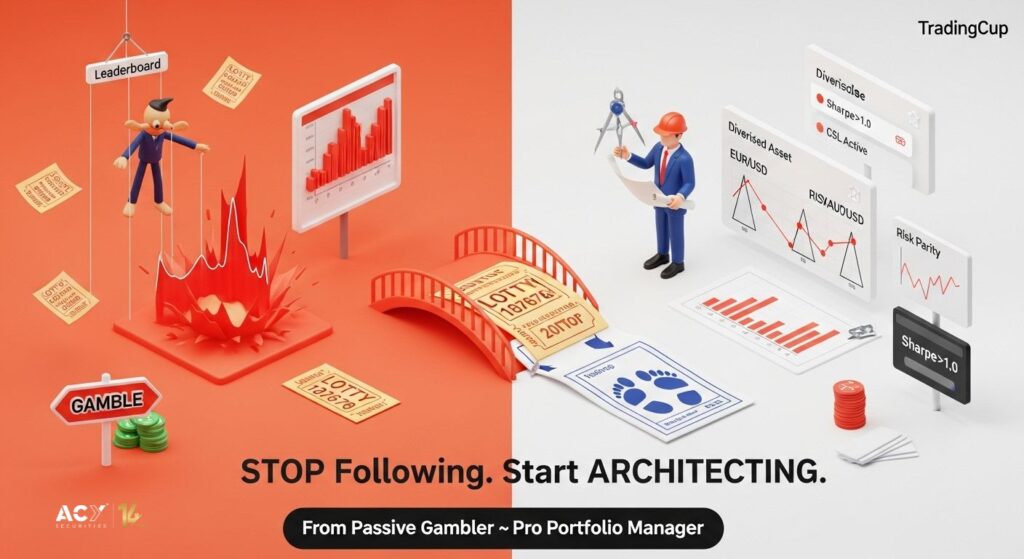
The initial promise of copy trading, an easy, hands-off shortcut to Forex profits, is an appealing but dangerous illusion. This report has demonstrated that blindly following a single star trader is not an investment strategy; it is a gamble that concentrates risk and cedes control, exposing an investor to a host of catastrophic failure scenarios.
True, sustainable success in copy trading is not found by searching for a perfect trader to follow. It is achieved by becoming the proactive architect of one’s own financial success. This transformation requires a profound shift in mindset: from being a passive follower to becoming a disciplined portfolio manager.
This means embracing the wisdom of Ray Dalio, understanding that resilience comes from the thoughtful diversification across multiple, uncorrelated strategies. It means internalizing the lessons of Van Tharp, recognizing that risk management, position sizing, and mastering one’s own psychology are the true keys to long-term profitability. And it means using a platform equipped with the right tools, transparent analytics like the Sharpe Ratio and essential defenses like the Copy Stop-Loss, to execute this intelligent strategy.
By moving beyond the lottery-ticket mentality of chasing leaderboards and instead building a resilient, diversified, and risk-managed copy trading portfolio, an investor can take genuine control of their financial journey.
Frequently Asked Questions
Is copy trading actually profitable?
Yes, copy trading can be profitable, but profitability depends heavily on strategy, not luck. Success is rarely achieved by copying a single trader. Instead, it typically comes from building a diversified portfolio of multiple traders with different strategies, implementing strict personal risk management using tools like stop-losses, and actively monitoring performance over the long term.
Can you lose all your money copy trading?
Yes, it is absolutely possible to lose all your money, especially if you engage in high-risk behaviors. The primary ways this can happen are by copying a single trader who has a catastrophic loss, allocating too much of your capital to one strategy, or failing to use risk management tools like stop-loss orders. All trading involves substantial risk.
What is the biggest risk in copy trading?
The biggest single risk in copy trading is concentration risk, putting all your funds into copying just one trader. This exposes you to a single point of failure. If that trader makes a mistake, gets emotional, or their strategy fails, your entire investment is jeopardized. The second-biggest risk is the failure to manage your own psychology, leading to emotional decisions like panic selling.
How do I choose a good trader to copy?
Choosing a good trader requires looking beyond their advertised ROI. A better approach involves:
- Analyzing Risk-Adjusted Returns: Use metrics like the Sharpe Ratio to see how much risk they took to achieve their returns.
- Checking their Maximum Drawdown (MDD): This shows the biggest loss they’ve ever sustained and indicates the potential risk you might face.
- Understanding their Strategy: Ensure their trading style (e.g., scalping, swing trading) and the assets they trade align with your own goals.
- Verifying Consistency: Look for a long track record of steady performance, not just a recent hot streak.
Is it better to copy one trader or multiple?
It is unequivocally better to copy multiple traders. Copying a single trader is a highly concentrated, high-risk strategy. Copying a diversified portfolio of 5-10 traders with different, uncorrelated strategies (e.g., different currency pairs, timeframes, and methods) significantly reduces your risk and creates a more resilient, stable equity curve, following the investment principles of experts like Ray Dalio.
How much money do you need to start copy trading?
The amount of money needed varies by platform, but many brokers allow you to start with as little as $100 or $200. However, to properly diversify across multiple traders (the recommended strategy), a larger starting capital (e.g., $1,000 or more) is more practical, as it allows you to allocate meaningful sums to several different traders without over-concentrating.
Is Forex copy trading better than stocks?
Neither is inherently “better”; they have different risk profiles. Forex copy trading benefits from extremely high liquidity and a 24/5 market, with movements driven by global economics. Stock copy trading is tied to corporate performance and market sentiment. Forex is often considered more stable and predictable than highly volatile individual stocks, but a diversified portfolio in either asset class is key to managing risk.
What is a good Sharpe Ratio for a copy trader?
The Sharpe Ratio measures risk-adjusted return. For a copy trader, a higher ratio is always better. A general guide is:
- Below 1.0: Sub-par. The returns may not justify the risk taken.
- 1.0 – 1.99: Good. This is a solid range for a competent trader.
- 2.0 – 2.99: Very Good. Indicates excellent performance relative to risk.
- 3.0 or higher: Excellent. This is rare and indicates exceptional risk management.
- When choosing traders, aiming for those with a Sharpe Ratio of at least 1.0 is a prudent starting point.
(Disclaimer: This article is for informational and educational purposes only. It should not be considered financial advice. Always conduct your own research and consult with a qualified financial advisor before making any investment decisions.)
For more detailed insights on developing daily trading routines, risk management, and effective position sizing strategies, explore additional articles on Trading Cup. Our trading experts at ACY and FinLogix are also great resources to guide your journey towards trading excellence.

Discover Our Best Trading Signals
At Tradingcup, you can browse through a selection of signals and review past performance before you decide to copy.
Become A Signal Provider
Share your expertise and become a signal provider so other traders can copy your trades.
Stay tuned to our blog for more trader spotlights and leaderboard updates.
Trading involves risks.
Visit the Tradingcup blog through the link below for more updates: https://www.tradingcup.com/learn
Related Copy Trading blogs:
- Understanding Market Liquidations: Liquidity Sweeps and Runs Explained
- 7 Essential Daily Habits of Successful Traders to Outperform Their Peers
- 10 Strategies You Can Copy off Our Best Copy Traders
- 5 Strategies Every Trader Can Master To Trade Better In A Trading Contest
- 2025 Copy Trading Scams Exposed: How to Spot Fraud
- A Swing Trading Strategy with an 83 Percent Win Rate and Low Drawdowns
- Forex Martingale Strategies Explained, The Good, The Bad and The Ugly
- Pyramiding Trading Tutorial – Pros & Cons & How to Use It