
Copy Trading Fees and Costs: What You Need to Know

TradingCup
MAR 28 2025
Last Updated: March 28, 2025
This article is reviewed annually to reflect the latest market regulations and trends.
TL; DR :
Copy trading fees typically include performance-based charges (5%–30% of profits) paid to signal providers (e.g., 20% fee = 200 on 1,000 gains) and platform fees like spreads, commissions, or subscriptions. While platforms like eToro offer “free” copy trading, they offset costs via wider spreads. Binance shares 10% of profits + trading fees with lead traders, while cTrader charges 10% of net profits.
Always verify fee structures, test strategies via demo accounts, and prioritize transparency to avoid hidden costs like slippage or overnight fees eating into returns.
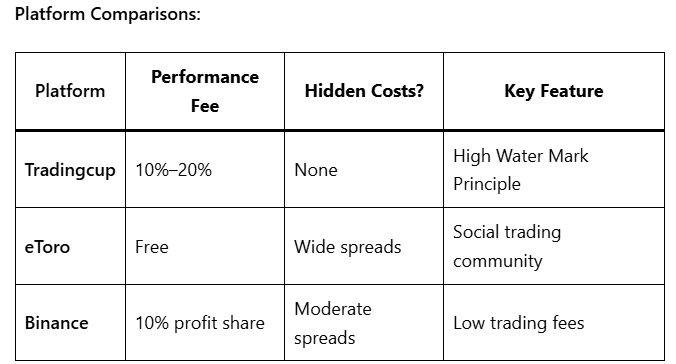
“In copy trading, fees are the silent partner in every profit; ignore them, and they’ll claim more than their share.”
Copy Trading Fees
Copy trading allows investors to mirror the trades of experienced traders, but fees can significantly impact profitability. Understanding these costs, from performance-based charges to hidden platform fees, is critical for both beginners and advanced traders.
This guide breaks down the essentials, including key principles like the High-Water Mark and Suggested Minimum Balance, to help you navigate copy trading costs strategically.
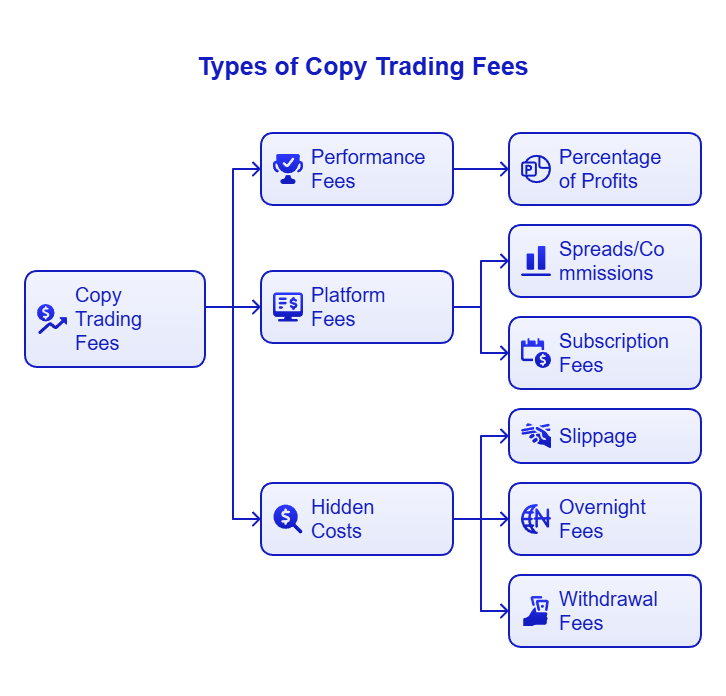
Types of Copy Trading Fees
1. Performance Fees
- What It Is: A percentage (5%–30%) of profits paid to signal providers.
- Example: A 20% fee on 1,000 profits = 200 deducted from your gains.
- Charged: Weekly or monthly, often labeled as “Signal Fees.”
2. Platform Fees
- Spreads/Commissions: Broker charges per trade (e.g., 0.5 pips on EUR/USD).
- Subscription Fees: Monthly access to premium traders (Free–30–500 on platforms like Tradingcup).
3. Hidden Costs
- Slippage: Trades executed at worse prices during volatility.
- Overnight Fees: Up to 0.1% daily for holding leveraged positions.
- Withdrawal Fees: Charges (1%–3%) when cashing out profits.
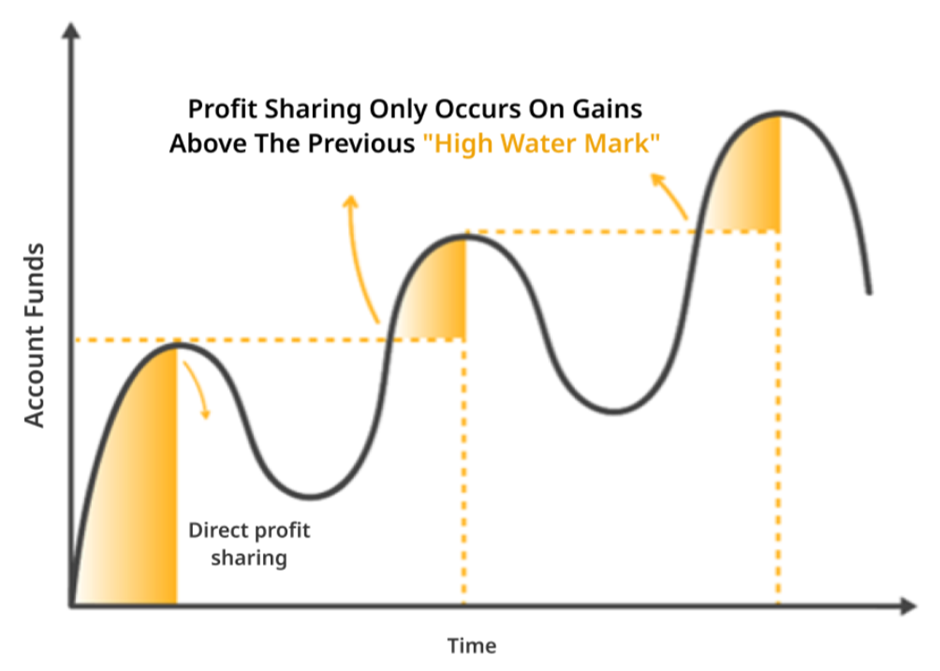
The High Water Mark Principle: Fair Fee Calculation
This rule ensures you only pay fees on new profits, not recovered losses.
How It Works:
- Set the Benchmark: Your account’s peak value becomes the “high water mark.”
- Fees Apply Only Above the Mark: If your account drops and rebounds, fees are charged solely on gains exceeding the previous peak.
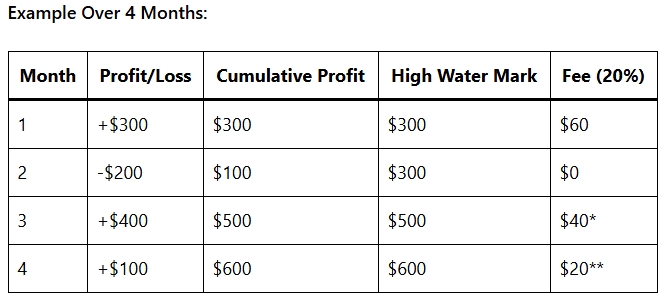
Why It Matters: Without this principle, you’d pay fees on the 500 rebound in Month 3 and the 100 in Month 4. The High-Water Mark saves $60 here.
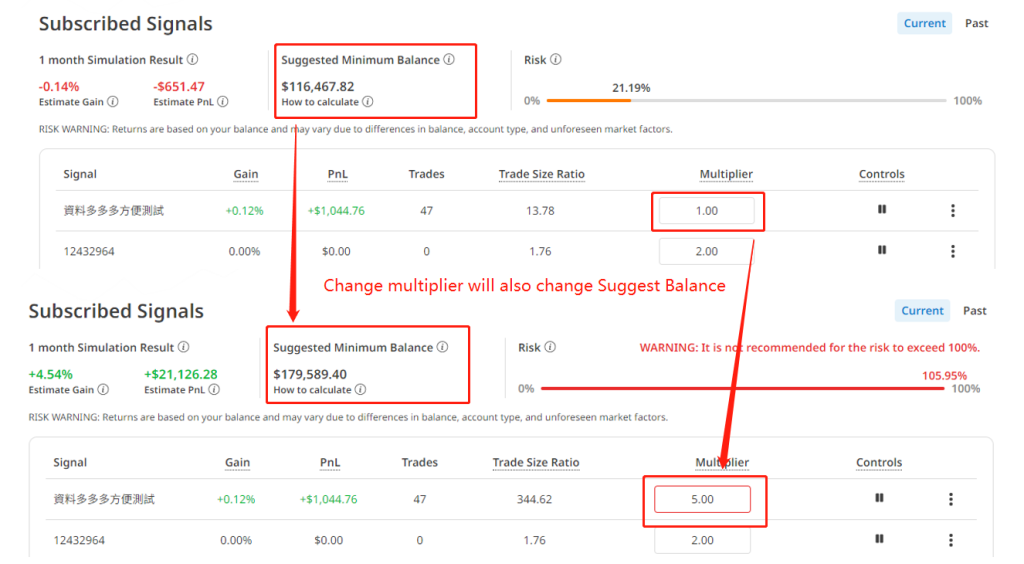
Suggested Minimum Balance: Avoid Missed Trades
Failing to meet minimum balance requirements can disrupt copy trading.
Common Issues:
- Minimum Lot Size:
- Example: A signal trading 0.01 lots with a 1k balance requires at least 1k to copy trades. With $500, orders fail.
- Maximum Position Overload:
- Example: A 10x multiplier on a 10k account copying 6-lot trades needs 60k margin, impossible without sufficient funds.
How Tradingcup’s Tool Helps:
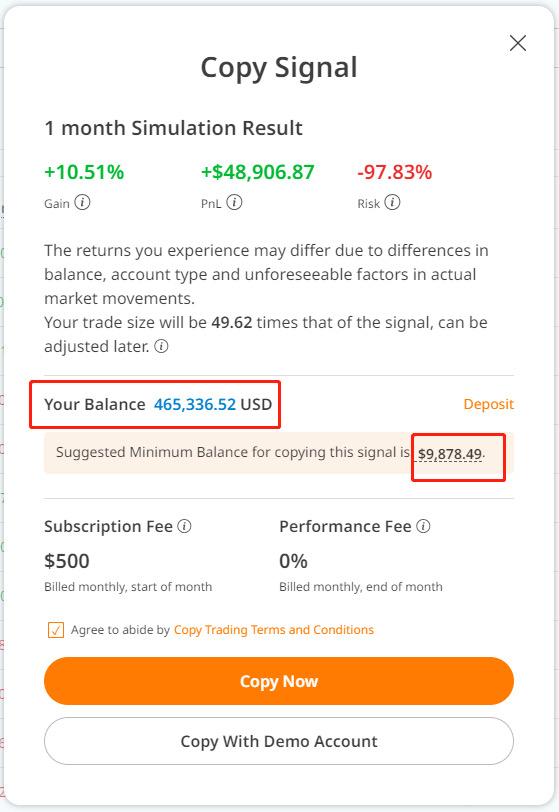
- Automatically calculates the minimum balance needed to mirror trades perfectly.
- Adjusts for multipliers and margin requirements.
FAQs:
Q: How much does copy trading cost?
A: Costs vary: performance fees (5%–30%), spreads, and subscriptions. Some platforms like eToro offer free copying but charge wider spreads.
Q: What’s the minimum amount for copy trading?
A: Depends on the platform and strategy. Tradingcup’s Suggested Minimum Balance tool provides clarity.
Q: Is copy trading good for beginners?
A: Yes, but avoid pitfalls like ignoring minimum balances or high-frequency traders (increased commission costs).
Q: How to reduce fees?
A: Choose platforms with transparent pricing (e.g., Tradingcup), avoid leveraged overnight positions, and withdraw profits strategically.
Q: Are performance fees worth it?
A: They incentivize signal providers to perform but compare historical returns against fees.

Mastering the Fees in Trading
- Audit Fees Regularly: Track performance fees, spreads, and hidden costs.
- Use the High Water Mark: Ensures fairness by charging fees only on new profits.
- Respect Minimum Balances: Prevent missed trades with tools like Tradingcup’s automatic calculator.
- Compare Platforms: Opt for transparency over “free” services with hidden costs.
For more detailed insights on developing daily trading routines, risk management, and effective position sizing strategies, explore additional articles on Trading Cup. Our trading experts at ACY and FinLogix are also great resources to guide your journey towards trading excellence.

Discover Our Best Trading Signals
At Tradingcup, you can browse through a selection of signals and review past performance before you decide to copy.
Become A Signal Provider
Share your expertise and become a signal provider so other traders can copy your trades.
Stay tuned to our blog for more trader spotlights and leaderboard updates.
Trading involves risks.
Visit the Tradingcup blog through the link below for more updates: https://www.tradingcup.com/learn
For further reading, visit acy.com