
83% Win Rate, 80 Copiers: How Does This Forex Signal Hold the #1 Spot on Tradingcup?

Peter Pan
NOV 20 2026
Last Updated: November 11, 2026
Disclaimer: The information in this article is for educational purposes only and does not constitute financial, investment, or trading advice. Copy trading carries substantial risks, including the potential loss of your entire invested capital. Past performance of copied traders or strategies is not a reliable indicator of future results. You may be replicating high-risk trades, overleveraged positions, or strategies incompatible with your financial goals. Always conduct independent research into a trader’s historical performance, risk metrics, and strategy before copying them. Never invest funds you cannot afford to lose. Consult a licensed financial advisor to ensure copy trading aligns with your risk tolerance, financial objectives, and regulatory requirements in your jurisdiction. This article does not endorse specific traders, platforms, or strategies, and all trading decisions remain your sole responsibility.
TL;DR
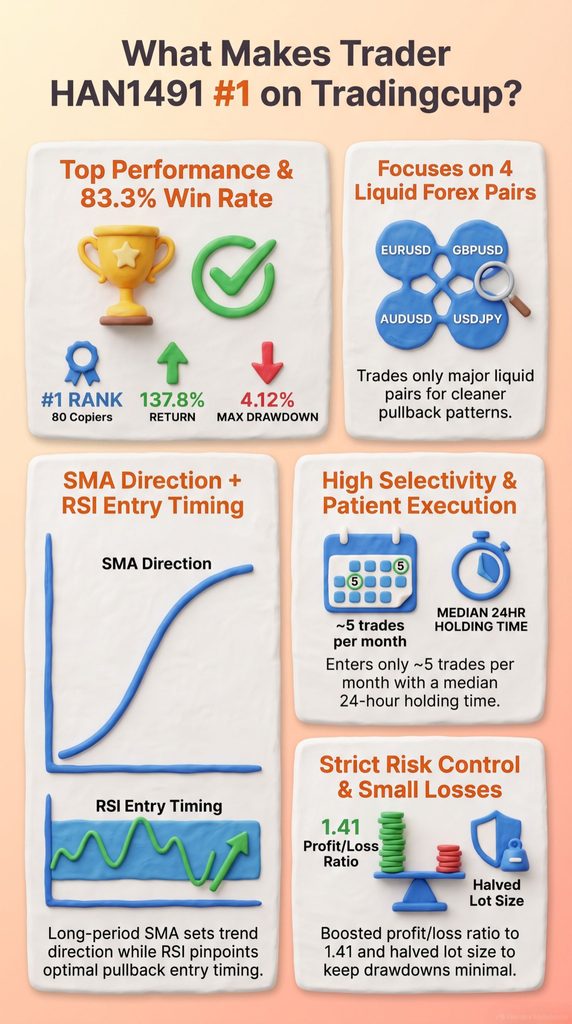
- #1 on Tradingcup: Ranks at the very top of the platform with nearly 80 copiers.
- Major-pair focus: Trades only four liquid pairs—EURUSD, GBPUSD, AUDUSD, and USDJPY.
- SMA + RSI setup: Identifies the trend with a long-term SMA and times pullbacks using RSI extremes.
- Moving average exit: Locks in profit once the price reverts to a short-term moving average.
- High-accuracy execution: Boasts an 83.3% win rate across 171 trading setups.
- Controlled risk: Maintains an asymmetric 1.41 profit/loss ratio and a minimal 4.12% max drawdown.
A Forex Mean-Reversion Strategy at the Top of the Leaderboard
On the Tradingcup MMR leaderboard, rankings rise and fall all the time. Yet HAN1491’s Pull-Back strategy signal has held the #1 spot for a long time, and nearly 80 investors are now copying it.
This signal trades at a slow pace. Since September 2024 it has placed only 171 trades, fewer than 7 a month on average, and its position sizes are modest. When the trend is unclear it mostly stays out, and it only enters once price has pulled back far enough.
So what keeps this signal at the top? Let’s take a closer look.
From Old Signal to New: An Upgrade by Subtraction
A year ago, we reviewed another HAN1491 signal with the same name. That signal later withdrew its profits and left, while this one, which he ran alongside it, never stopped. It has now been running for more than two years, and it is today’s #1 signal.
Comparing the two accounts, the upgrade shows up in two areas:
- Fewer instruments: The old signal traded 15 instruments. The new one keeps only four major pairs: EURUSD, GBPUSD, AUDUSD and USDJPY. They are liquid, have tight spreads, and tend to pull back in more regular patterns.
- Stricter stop losses: On the old signal, the average loss was larger than the average win (a profit/loss ratio of 0.88). The new signal has lifted that ratio to 1.41. When a single entry goes the wrong way, it is cut quickly for a small loss.
As a result, this signal keeps its high win rate while earning more efficiently on every trade.
SMA for Direction, RSI for Timing
The signal description only says it uses SMA and RSI to trade pullbacks, and it gives no further rules. Based on the author’s observation, the signal most likely uses a long-period SMA to set direction: it only buys when the trend points up and only sells when it points down. It then uses RSI overbought or oversold readings to time its entries. It adds positions against the move, closes everything once price returns above the short-period moving average, or cuts the loss if price fails to come back.
The long-period moving average sets the direction. Short-term moves in FX tend to continue the existing trend, so trading only with the bigger trend avoids many counter-trend losses.
RSI judges whether the pullback has gone far enough. In an uptrend, the signal waits for RSI to drop into oversold territory before buying. In a downtrend, it waits for RSI to reach overbought before selling. This gives it a relatively better entry price.
The exit target is price returning to the short-term moving average. That target sits close to the entry and is much easier to reach than a full trend leg, so the win rate naturally stays high.
Key Performance Highlights
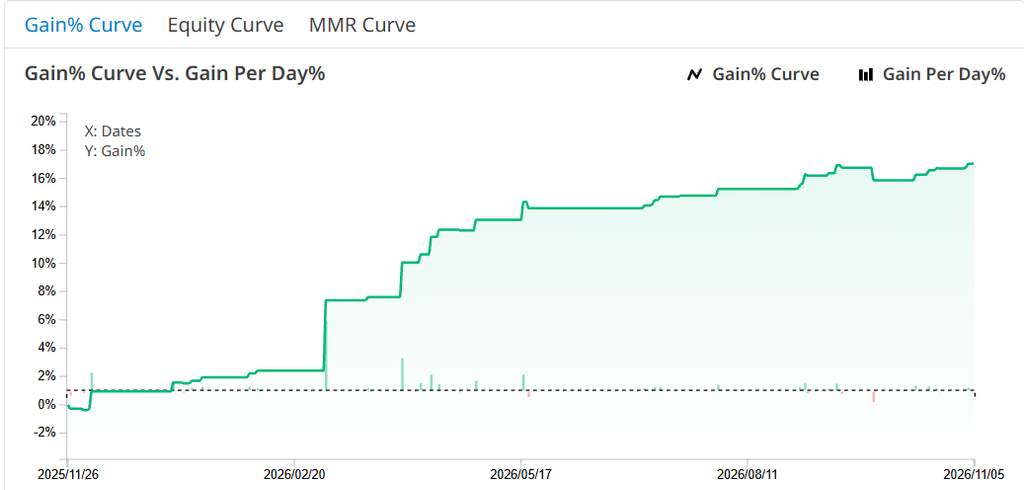
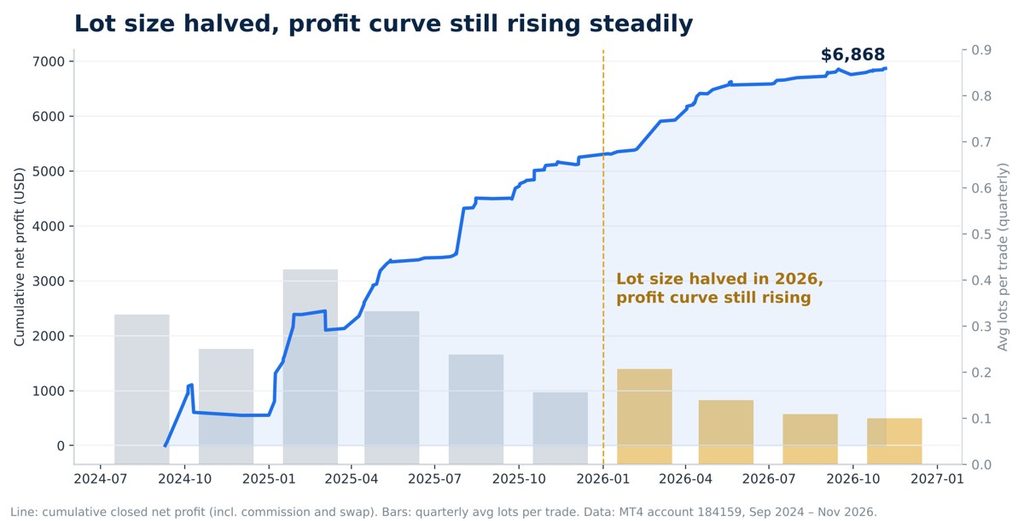
Since it began trading in September 2024, the signal has completed 171 trades, with a profit factor of 3.42 and a cumulative return of about 137.8% excluding deposits and withdrawals.
1. A Win Rate Far Above the Breakeven Line
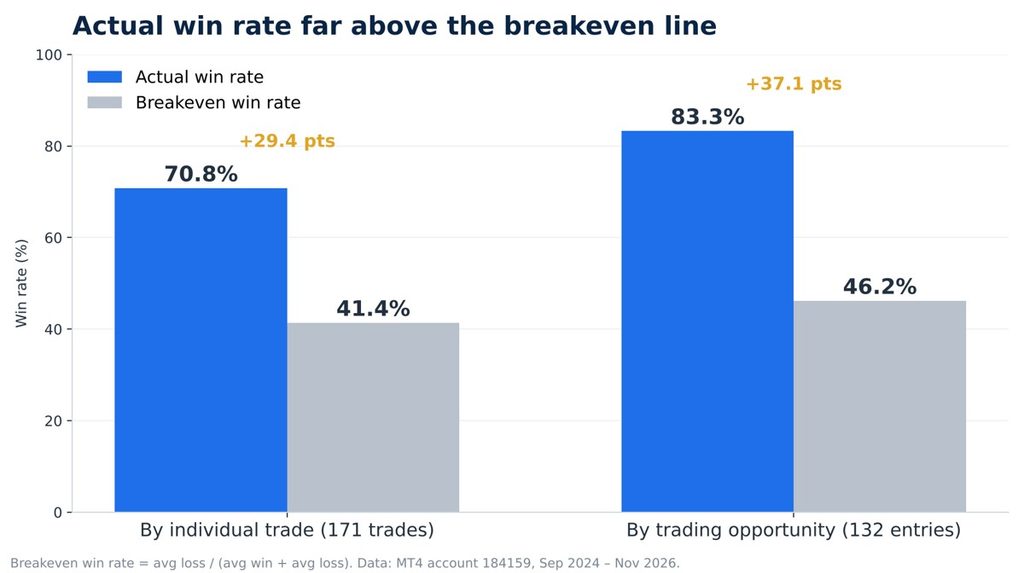
Across 171 trades, the win rate is 70.8%. If add-on positions from the same entry are grouped as one trading opportunity, 83.3% of the 132 opportunities ended in profit.
With an average win of $80.2 and an average loss of $56.7, any win rate above 41.4% would be enough to avoid losing money. The actual win rate sits nearly 30 percentage points above that breakeven line, and this is what underpins the signal’s steady profits.
2. Low Trading Frequency, Patient Waiting
Counted by trading opportunity, it enters only about 5 times a month, with a median holding time of about 24 hours. When conditions are not met, it stays flat. Once in a trade, it is in no hurry to leave and closes only when price reaches the target. The high win rate largely comes from this selectivity: it trades only the setups it is most confident in and waits patiently for the result. Few signals on the leaderboard keep this kind of rhythm, which may be why it holds the top spot.
This approach is also backed by academic research. “Currency momentum strategies” by Menkhoff et al., published in the Journal of Financial Economics in 2012, found significant momentum in the foreign exchange market: currencies that have recently strengthened tend to keep strengthening, weak ones tend to keep weakening, and the excess-return spread between them can reach up to 10% a year. The study also links this pattern to investors’ medium-term “under-reaction” and short-term “over-reaction”.
Applied to this forex strategy, under-reaction lets trends persist, so a long-period moving average is used to trade with the trend. Over-reaction creates short-term deviations, so RSI is used to wait for a proper pullback before entering. Momentum for direction on the medium term (SMA) and pullbacks for entry on the short term (RSI) is likely a key reason behind its very high win rate.
3. Most Trades Need No Add-ons
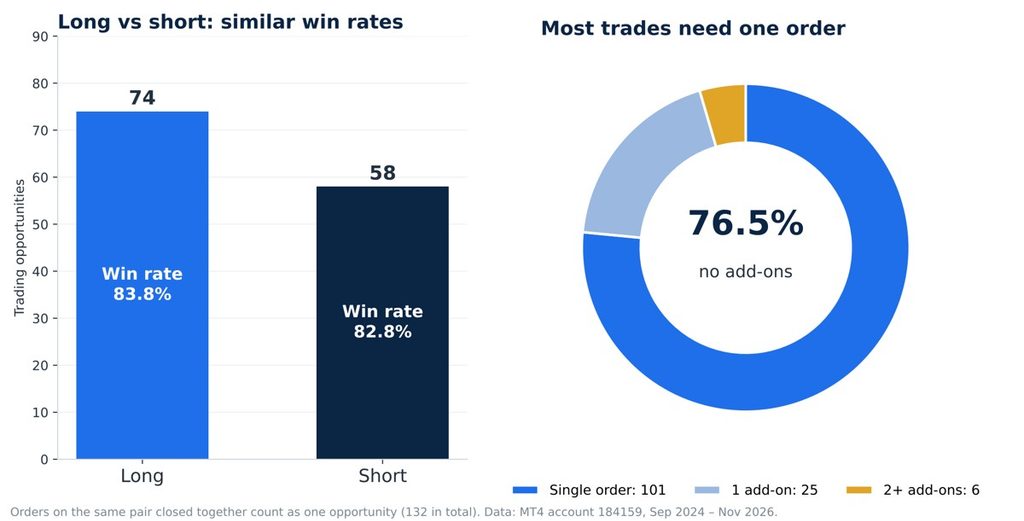
Although the strategy allows adding positions against the move, 76.5% of trades were completed with a single order, and only 6 ever reached a third layer or beyond. When forex turning points are read accurately, there is little need to add positions to “rescue” a trade, which also lowers the risk of a large drawdown.
4. Lot Size Halved in 2026 for a More Stable Style
In 2026, the average lot size per trade fell from 0.28 to 0.14 lots, while the win rate held at 83.6%. Platform data shows a maximum drawdown of only 4.12% over the past year. Account swings are noticeably smaller, which makes the signal friendlier for copiers.
Final Thoughts
Simple rules, a focused set of instruments, restrained trading frequency and steadily tighter risk control keep HAN1491’s forex strategy firmly at the top of the leaderboard. The choice of nearly 80 copiers also reflects the market’s recognition of this steady style.
Keep in mind that a counter-trend strategy can carry large floating losses while it is adding positions. Before copying, set your capital and lot size according to your own risk tolerance. To learn more, visit the Tradingcup signal page for live data.
Risk warning: Past performance is not indicative of future results. This article is for general information only and does not constitute investment advice.
Looking for the Best Copy Trading Strategy?
We’ve compiled a leaderboard of the most outstanding traders with excellent drawdown control and clear trading styles. This way, you’ll never feel lost when choosing who to follow and won’t blindly chase trends. Click to view the latest trader rankings and find out who is truly worth copying! Choose the right person, copy the right strategy, and from today, let copy trading truly create value for you.
Bonus Guide
What Makes an Effective Trading Portfolio?
- Diversification: Spread funds across various asset types (e.g., stocks, bonds, real estate, cash, precious metals) and industries/regions to reduce exposure to single-market volatility.
- Asset Allocation: Tailor allocations based on your risk tolerance, goals, and time horizon. Conservative portfolios emphasize fixed income, while aggressive ones lean into equities.
- Risk-Reward Balance: Each asset has different risk/return profiles. Ensure your portfolio avoids excessive exposure to high-risk or low-return assets.
- Low Correlation: Combine assets with correlations below 0.3 to enhance stability and provide a cushioning effect during market swings.
- Dynamic Rebalancing: Review and adjust your portfolio regularly as markets or personal goals change to stay aligned with your risk-return expectations.
- Clear Objectives: Define your financial goals (retirement, housing, education) before designing your strategy and time horizon.
- Discipline & Logic: Stick to your trading plan without emotional decision-making. Regularly reassess assumptions and market conditions.
(Disclaimer: This article is for informational and educational purposes only. It should not be considered financial advice. Always conduct your own research and consult with a qualified financial advisor before making any trading decisions.
For more detailed insights on developing daily trading routines, risk management, and effective position sizing strategies, explore additional articles on Trading Cup. Our trading experts at ACY and FinLogix are also great resources to guide your journey towards trading excellence.

Discover Our Best Trading Signals
At Tradingcup, you can browse through a selection of signals and review past performance before you decide to copy.
Become A Signal Provider
Share your expertise and become a signal provider so other traders can copy your trades.
Stay tuned to our blog for more trader spotlights and leaderboard updates.
Trading involves risks.
Visit the Tradingcup blog through the link below for more updates: https://www.tradingcup.com/learnBest blogs top 8 code to use if needed.
Related Copy Trading blogs:
- Understanding Market Liquidations: Liquidity Sweeps and Runs Explained
- 7 Essential Daily Habits of Successful Traders to Outperform Their Peers
- 10 Strategies You Can Copy off Our Best Copy Traders
- 5 Strategies Every Trader Can Master To Trade Better In A Trading Contest
- 2026 Copy Trading Scams Exposed: How to Spot Fraud
- A Swing Trading Strategy with an 83 Percent Win Rate and Low Drawdowns
- Forex Martingale Strategies Explained, The Good, The Bad and The Ugly
- Pyramiding Trading Tutorial – Pros & Cons & How to Use It